by John Crowley | Sep 17, 2026 | Uncategorized
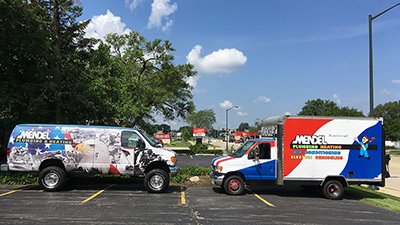
RESIDENTIAL: How One Illinois Contractor Turned Classic Trucks Into Marketing Machines Breast cancer awareness. Thanking first responders. Baseball season. Supporting the U.S. military. Mendel Plumbing & Heating Inc. in St. Charles, Illinois, has a dedicated fleet of custom-painted trucks and vans to observe every occasion. “I like the old trucks,” says Mike Mendel, Mendel’s Owner and CEO. He started his collection of one-off trucks 10 years ago, and over time they’ve grown into viral marketing tools, providing unique advertising opportunities for every seasonof the year. “It turns out that they’re good marketing pieces.” Mendel reserves about 50 trucks for the routine work that every residential sheet metal contractor does, with 10 to 12 additional trucks and vans set apart for other causes and events. “They have special paint jobs, depending on if they’re used for just showing our business or if they’re used to support a cause,” Mendel says. The humane society asked for support? He had a truck painted to encourage pet adoption. It’s Mental Health Month? Mendel had a truck painted green to increase visibility. Memorial Day is coming? Mendel has multiple trucks decorated with patriotic and military themes that honor our veterans. The community pays attention to Mendel’s imaginative trucks. Nonprofits and media outlets feature his trucks on their social media. When he used a pink truck to highlight breast cancer awareness, thousands of people liked Mendel’s Facebook page to raise money for a cancer resource center. Members of the public took photos of themselves with Mendel’s gold-themed “Pediatric Cancer” van to commemorate Childhood Cancer Awareness Month. And Mendel’s orange “Random Acts of Kindness” van appeared on NBC Channel 5 in Chicago to promote a local nonprofit that invites everyone to change the world by showing kindness to their neighbors. Parades in St. Charles draw thousands of spectators, and Mendel is a regular supporter. He might send three branded trucks to a single parade. “Sometimes we can hand out candy,” Mendel says. “Other times you’re not allowed to. The different parades dictate what you can do.” The number of participants Mendel sends to each parade also varies. “Sometimes it’s just a few guys driving the trucks, but other times we’ve had walkers. It depends on what the parade allows, and it depends on what people are doing the weekend that the parade falls.” Mendel is already considering a Christmas truck for the 2026 Holiday Homecoming, a two-day festival which the St. Charles website bills as “one of the Midwest’s most spectacular holiday events.” Mendel has sponsored both the St. Charles Electric Christmas Parade, which is held the Saturday after Black Friday, and its St. Patrick’s Day Parade, which is held in March. As a parade sponsor, Mendel is listed on the official city website all year round. “We’re signed up for the year on different parades,” Mendel says, “but you don’t have to do it that far in advance.”The Mendel truck collection opens another unconventional marketing prospect: car shows. “You probably could go to a show every day here,” Mendel says. “I drove by one last night. It’s at a restaurant west of town, and I think it’s every Wednesday. Car shows are held in the summertime, usually in the evening for a few hours, but they’re all going to be different, so some might start a little earlier.” Car owners can travel long distances to participate in shows, but Mendel chose venues close to his service area. He found the local car shows online. “There are websites that you can search for old car shows. Some of the shows you might have to pre-register for, but you can just drive up to most shows.” Sometimes Mendel’s fleet manager has taken multiple Mendel-branded trucks to three car shows in a week. Mendel also uses the trucks to draw attention to his office in St. Charles. The parking lot is on a main road, so simply parking a distinctive truck there serves the purpose of a billboard or a sign. “There’s some good visibility,” Mendel says. “We change up what’s parked there, on average monthly, though sometimes we’ll have something up a little longer.” When the trucks aren’t on display, Mendel keeps them in one of his buildings. The cost of buying the trucks depends on their type and age. “You can spend a ton of money on old trucks, or you can get them for not too much,” Mendel says. One of his dedicated trucks was originally used for regular residential work, while the rest were purchased specifically for promotional purposes. “Some of those are early 2000s, but we bought older trucks when we found them, so it’s a mixture of ages and styles.” One truck is wrapped with the letters painted on, but the others are completely painted with no wrap.Mendel doesn’t know how many customers his trucks have brought in. “There’s not a way to measure that,” he says. “We don’t get people going, ‘I saw your old truck at the parade and that’s why I called.’” But he’s very happy with this inventive marketing strategy. “Remember, it’s something I like.”
by John Crowley | Sep 14, 2026 | Uncategorized
Leading Without Limitations It’s lunchtime, and Michelle Acosta is alone at the will-call counter.She’s 18, maybe 19, covering the counter by herself while the rest of the crew at her grandfather’s sheet metal manufacturing company is at lunch. A customer walks up needing fittings. “You can’t help me here,” he tells her. “You’rea girl. ”Acosta doesn’t blink. “I do this all day, every day,” she tells him. “Everybody’s at lunch. You can either sit in your truck and waste 30 minutes, or you can tell me what you need, and I’ll have you out of here in 15 minutes. Your call.” He stays. She fills the order.It’s a small showdown, over almost before it starts. But it captures something Acosta, now Vice President of Business Development at ATS Mechanical in San Jose, California, has lived through in one form or another for two decades. She started at Acosta Sheet Metal Manufacturing at 15, answering phones. By 17, she was teaching herself to write orders by watching over the shoulders of the men in inside sales, because, as she puts it, “nobody wanted to give me a chance.” By the 2008 recession, with the company short-staffed, she’d talked her way onto the shop floor doing shipping and receiving, carrying spiral duct, loading trucks and filling in wherever the business needed her. There was one problem nobody had planned for: none of the company’s protective equipment came in her size. “I was swimming in them,” she says. “I was maybe 115 pounds soaking wet, and the shirts were hanging off me, so I did my best to tuck them in as much as I could.”A teenage girl in men’s-large shirts, doing a job nobody thought she’d want is, in miniature, the story of women in sheet metal and HVAC right now. More are in the building than ever before, and national data backs that up. But the equipment, the culture and the paths into the industry were mostly built without women in mind. Closing that gap is the work SMACNA and its members are now visibly, deliberately taking on.WHAT THE NUMBERS SAYWomen made up 11.2% of the U.S. construction workforce in 2024 — the highest share in 20 years and up from just 9.1% in 2017, according to the National Association of Home Builders’ analysis of federal labor data. That’s 1.34 million women, a number that has finally climbed back past pre-2008-recession levels after bottoming out at 802,000 in 2012. Growth has continued. Industry analysis of Bureau of Labor Statistics figures compiled by Fixr.com found women added roughly 22,000 net construction jobs between 2024 and 2025, pushing their share to 11.3%. A regional analysis by Associated Builders and Contractors’ Carolinas chapter found women’s participation in construction grew 45% between 2016 and 2025. And in 2025, women filled 12,000 of the 14,000 net new construction jobs added nationally, even as overall hiring slowed.Acosta, who dug into the same data while thinking through her own story, put a finer point on it. “Women represent approximately 11% to 14% of the U.S. construction workforce,” she says, citing California’s Labor & Workforce Development Agency, “marking a historic high driven by a 45% increase in female participation over the past decade. This figure lines up with the Institute for Women’s Policy Research, which found women held just 4.3% of construction trade jobs nationally in 2024, even after a 77.3% increase in the number of tradeswomen since 2015. In three of the industry’s five largest trades, women’s share is smaller still: 3.5% of laborers; 3.2% of plumbers, pipefitters and steamfitters; and 2.9% of electricians.Acosta’s read on why the gap persists tracks closely with an analysis published in March 2026 by Bluebeam’s Built blog, which found retention, not recruitment, is now the industry’s real bottleneck. “Retention is the issue,” Acosta says, “or as I describe it, a symptom. The underlying problems are everything from culture fit on the jobsite to the literal lack of fit of necessary PPE and everything in between.” The Bluebeam analysis backs her up, pointing out that women enter construction training and apprenticeship programs at higher rates than a decade ago, but leave the trades at higher rates than men, particularly in the first year. This is driven by isolation, thin mentorship and jobsite conditions like PPE that were never designed with them in mind. A 2025 industrial safety survey found more than one in five women linked a workplace injury directly to equipment that didn’t fit — the same problem, in a different decade, that had a teenage Acosta tucking men’s work uniform shirts into her waistband because there was no alternative.Athena Chiera, Vice President of Athena Engineering in San Dimas, California, gives the honest, unsentimental version of that same trajectory from inside a company her parents founded in 1984. “It’s better, but don’t pop the champagne,” she says of where the industry stands now versus when she started. “There are more of us, more contractors who want us there, and more clients who genuinely expect it. But the numbers at the top and in the field are still thin, and too many women get in and then quietly leave because the culture treats them like guests. We’ve moved the needle. Now we have not finished the job.”NO SINGLE FORMULAAsk how these women arrived in sheet metal and HVAC, and the honest answer is almost none of them planned to and almost no two of them arrived the same way. There’s an engineer who didn’t know what sheet metal was until she was 28, a grandfather’s receptionist who taught herself the business from the back of a cubicle, a bank employee who took over her father’s fabrication shop, a CFO who backed in through an accounts-receivable job, a Ph.D. in Shakespeare who found herself drawn into estimating, and a union ironworker’s spouse who volunteered for a finance job she wasn’t trained for. Chiera says her path had two separate beginnings.“The first is that I was born into it,” Chiera says. “My mom, Jannie, started Athena Engineering in 1984 and had the guts to do it. My dad, Richard, was the technical one, but my mom was, and still is, the heart and the brains of this company. She blazed the trail I get to walk. I grew up on jobsites with my own toolbox, keying invoices at six and calling vendors to bid jobs at 11.” The second beginning, she says, was the one she chose: coming in as a sales and business development professional during the 2008 financial collapse. Her goal was simple: to help the family business survive. “I thought I was just pitching in,” she says. “It turned out to be a natural fit, and I never left. So, the path found me first, and then I chose it right back.”Jen Clark, Project Integration Manager at General Sheet Metal in Portland, Oregon, thinks that range of paths is an important part of the industry’s story, but that the underlying imbalance is still very real. Chiera goes one step further, arguing that the framing itself does specific damage before a girl ever gets near a jobsite. “By the time we recruit at the apprenticeship or college level, most girls have already crossed us off [the list],” she says, “not because a door slammed, but because we spent their childhood calling this industry ‘male-dominated.’ That phrase is well-meaning and it’s poison; it tells a 10-year-old the seats are taken before she ever considers one. An industry has no gender. Stop giving it one.”WHAT SMACNA IS BUILDINGThe industry isn’t just tracking this shift from the sidelines. SMACNA is actively building infrastructure around it. The association’s National Women in Leadership Committee, chaired by Kathy Kerber, President and COO of KSM Metal Fabrication in Troy, Ohio, has spent the past several months rebuilding momentum after a quieter stretch, and the growth has been fast. The committee’s private LinkedIn community, “Trailblazing Women in Sheet Metal and HVAC — Connected by SMACNA,” has grown from zero members to more than 70 since its launch, giving women across the industry — in the office, in the field and in leadership — a place to connect with peers and mentors that didn’t exist in this form before.The committee meets twice a year, with a stated goal of making sure every avenue available to SMACNA members is genuinely open to the women working in the industry, whether they know those doors exist yet or not. Acosta has felt that outreach firsthand. She serves on the Bay Area SMACNA board, a seat she also didn’t wait to be invited into. “I just simply started going,” she says of her early involvement. “I wanted more of that. I just charged my credit card and went.”That kind of direct, on-the-ground exposure is also happening at the shop level. Devon Madon, Co-owner of Madon Sheet Metal near Chicago, recently hosted a Heavy Metal Summer Experience event at her shop, bringing students in to see what a career in the trade could look like up close. “One of the highlights of the day was connecting with several young women who were excited to explore opportunities in manufacturing,” she says. “Their curiosity, confidence and eagerness to learn were inspiring.” Clark points to the same program in Portland. “That’s the importance of things like Heavy Metal Summer Experience — trying to reach out to younger people … it’s just making the trades a valid option.”Gina Medel, Chief Financial Officer of The Penn Air Group in Cypress, California, has taken a similarly hands-on approach in Southern California, giving tours of the local Joint Apprenticeship and Training Committee facility to friends’ sons and daughters alike. “I try to do my best because the industry is so great, and we just don’t market it enough,” she says. Her advice to anyone weighing the industry: “Take a chance. If you love what you do, the money will follow.”Alongside the Women in Leadership Committee, SMACNA runs a second, broader effort aimed at the same underlying concern: making sure people in the industry are representative of the greater population. The Representation, Integrity, Support, and Empowerment Committee (RISE), a joint effort between SMACNA and the sheet metal workers’ union SMART, is barely two years old, and Renee Hoffman, Business Manager at Miller Sheetmetal in Bremerton, Washington, is one of its newer members. She joined, she says, after realizing she wanted a more direct hand in the conversation than the hallway small talk she’d been having on her own. “It’s just including everybody and helping those who are underrepresented,” she says of the committee’s focus, which extends well beyond gender. “I wanted to be able to do more.”RISE also administers, alongside SMACNA’s Safety and Health Committee, an annual Safety Sponsorship — up to $5,000 toward attending the National Safety Council’s Safety Congress & Expo — in partnership with SMACNA’s BE4ALL initiative. Hoffman won the award in 2025, recognized for a safety program built on the same instincts that got her into finance: showing up, asking questions and refusing to let anything stop her. “Safety is more than just following rules; it’s about planning, communicating clearly and looking out for each other on every job,” she says. “As our company grows, we want to make sure our systems, training and leadership grow with it.” Chiera won the same sponsorship in 2025. She built Athena Engineering’s safety program essentially from scratch after joining full time in 2008 — work later recognized separately by the company’s insurer, the ICW Group. “I’ve spent 18 years running our safety program while sending everyone else to the conferences,” Chiera says. “This scholarship is the first time it’s been my turn.” She’s using the recognition to push further, including expanding mental-health awareness at her company; improving near-miss reporting; and pressing on three concrete, practical fixes for women in the field: PPE that actually fits, reliable bathroom access on jobsites and stronger channels for reporting harassment.Chiera’s involvement with SMACNA goes back further than the award. Athena Engineering has been a member “for a long time,” she says, and the company made a deliberate bet on training when it went union in 2005, “because we needed access to better training and more skilled people.” She’s since joined the National Association of Women in Construction, sits on an advisory board for the Air Conditioning, Refrigeration and Controls program at Mt. San Antonio College, and counts some of her closest professional friendships among tradeswomen nearing retirement who spent entire careers on the tools without ever being asked for their story. “Their stories deserve to be told before they walk off the job for the last time,” she says.But several of the women make the same larger point: fixing safety protocols isn’t accommodation for women; it’s a safer jobsite for everyone. Clark makes the case from the field. “I can’t go out and lift 200 pounds over my head, so I’m probably going to be safer because I’m not trying to out-macho anybody,” she says. Bringing in people of different sizes, strengths and backgrounds, she argues, pushes crews to use the lifts and equipment they’re supposed to “because we all want to go home at night.”PROVING IT TWICEAsk several of these HVAC and sheet metal professionals what got in their way as they explored industry careers and a specific pattern shows up. There was a quiet assumption that the woman in the room isn’t the one in charge.Chiera describes it as a fact of life on the sales side of the business, even now. “Men who were perfectly friendly with each other would see a woman walk up and assume she was a stand-in for the real decision-maker,” she says. Two moments from her career have become the stories she tells to explain what that assumption costs and what refusing it looks like. The first is a job walk where the electrical panel she needed to inspect sat inside the men’s locker room, and she was told she couldn’t go in. “I told them they’d have to cancel the entire RFP because a walk I’m not allowed to complete isn’t a fair bid,” she says. “Then I knocked on the door, told the men inside to put their underwear on because I was coming in, and I walked in and did the walk.” The second, which was smaller but just as telling was when a crew offered to save her the trouble of a roof inspection. “‘Don’t worry about climbing the ladder to the roof. We’ll just tell you what’s up there,’” she remembers being told. “‘No thank you. I’ll climb the ladder and see for myself,’” she said back. Her rule for moments like these hasn’t changed: “I don’t get loud, I don’t get small, and I don’t let it become the story. I refuse the smaller version of the job someone’s trying to hand me.”Kerber describes a version of the same dynamic that lasted years rather than minutes. “Customers and vendors refused to talk to me and thought I had no idea what I was talking about,” she says of her early years at KSM. “It’s easier not to tell people who you are sometimes and just get a male counterpart to deal with some people.” Acosta’s counter-scene is the same test. A stranger decided, on sight, that she couldn’t possibly be the person equipped to help him. All three describe handling it the same underlying way: not arguing the point; just doing the job anyway and letting the work settle the argument.THE DRIVE IT TAKESTalk to any of these industry professionals long enough, and a theme surfaces that has nothing to do with gender: none of them waited around.Acosta calls it resourcefulness and traces it back to her first months in inside sales, teaching herself to type orders by watching coworkers when nobody would train her directly. “I think resourcefulness — essentially not waiting for people to give me an opportunity but rather just simply taking it for myself — is kind of a theme in my life,” she says. Kerber describes something similar from her own experience building a company culture around it. “I was born somewhat of a leader,” she says. “I also have sought out leadership training, workshops and one-on-one development to help me in my career. I like being a leader, and I like to develop leaders.” Clark’s version of the same instinct shows up in how she got her current role. She didn’t wait for a job posting.“I went to the president ofthe company with an idea,” she says, “and he said, ‘You know what, that sounds likea great idea.’” Hoffman’s came from raising her hand for a job running the company’s finances that she wasn’t trained for yet, then closing the gap on her own time. “I can do this,” she remembers telling herself. “I can do whatever I put my mind to.”Medel frames it as focus rather than proving a point. “I never looked at it like, ‘Oh, I’m a woman here,’” she says. “I looked at it like, ‘How can I be productive, how can I be effective and what can I contribute?’ I just wanted to do the work.”All of them describe a genuine, if hard-won, advantage that comes with being one of relatively few women in rooms that used to have none. “When you’re one, if not the only, woman in the room, you’re more easily recognized and remembered,” Acosta says. “When you’re the one who’s not like the others, people are curious, and that’s helped me get an entry point into interactions and groups that let me then show who I am and what I’m about.” Clark describes it in terms of trust. “I think there’s just less of an ego thing going on,” she says. “People feel comfortable brainstorming with me or being open with me in a way they don’t necessarily feel as comfortable doing with another guy.” Kerber calls it “a gift where we’re empathetic but strong at the same time … sometimes we do better at seeing the big picture, and when that happens, we truly can bring unique input.”Chiera puts the sharpest point on it. “Being the only woman in the room is always an advantage because nobody ever forgets me,” she says. “I’m 5’2”, Cuban, Italian, and definitely not quiet, so I don’t need a gimmick to stand out. For the record, I don’t do the pink hard hat. I like pink fine; it’s just not my color. In a sea of sameness, being different is memorable, and memorable wins work.”THE PART THAT ISN’T SOLVED YETNone of the professionals who talked to SMACNews oversell the progress of women in the industry.Kerber is candid that the trend line hasn’t been straight. “For a while, I felt it was getting better, and we were making a difference,” she says. “Now, I am not so sure. It seems like we have taken a back seat again. Hearing some comments from male colleagues feels like we are going back in time.” Asked about the most common misconception outside the industry, she says, “I think they think we are figureheads sometimes, but if you really looked at it, we show up, put in the time and the work, and we contribute a lot.”Acosta zeroes in on something more structural: an industry-wide instinct to make newcomers (regardless of gender) earn their place through unnecessary hardship rather than real mentorship. “There is such an immense desire to say, ‘This is how I suffered, so you gotta suffer, too,’” she says. “I’m not saying we need to make it easy, but why do people have to suffer and make mistakes that aren’t helping anybody learn? They’re just making people feel bad.” She thinks that pattern, more than any single act of bias, is what actually drives people out. “I think companies forget that it is their obligation to help people grow,” she says. “None of us come out of college, an apprenticeship or a trade already knowing everything. I think once people get far enough in their careers, they forget what it was like to be a beginner.”Chiera’s version of the same worry centers on visibility, and who the industry lets stand in for “women in construction” in the first place. “Scroll construction TikTok and the vast majority of women you’ll see are young project engineers at big general contractors,” she says. “Great job, nothing against it, but it’s one narrow lane. What you don’t see on the socials are the female welders, pipefitters and electricians. You know why? You can’t film yourself while you’re bending conduit, arc welding or sweating a pipe. Those women have their heads down doing the actual work, and we desperately need their stories out there.” She’s equally blunt about the misconception that follows from that gap. “That we’re the exception that proves the rule — that a woman doing this work must be some rare unicorn who had to be twice as tough to get here. It flattens us into mascots.” And Chiera doesn’t let the industry off the hook on retention, the same word Acosta and the national data both keep circling back to: “Retention is the real scoreboard, and we’re not winning it yet.”Hoffman, whose shop hasn’t yet had many women come through the field, says the fix must be ready before the need arrives, not after. “If a woman would need something,” she says, “we would absolutely add that to what we do.”WHERE IT’S HEADEDAsk all the professionals what they’d tell a young woman weighing this career, and the answers land in roughly the same place, even if the delivery differs.Madon, who came to Madon Sheet Metal from a Ph.D. in Shakespeare and a decade of teaching, wants the industry to make its intellectual case louder. “I wish more people asked how the humanities and manufacturing complement one another,” she says. “People think they’re opposites; my experience has been the exact opposite.” The same skills — critical thinking and communication — that she taught in a classroom are the ones she now uses to estimate and run a shop, which leads her to how she’d frame the trade’s future. “It’s not just about building better products. It’s about building better thinkers.“You won’t know until you give it an honest try,” Madon adds. “And one bad apple — a terrible boss, a terrible company culture or one bad situation — doesn’t define the industry. Move on, reassess.” “Don’t think that you need to be able to lift things that are heavy, or that you can’t do certain things — go out and try it,” adds Hoffman. “If it’s worth having, it’s hard to get.” When the topic of work-life balance comes up, Chiera doesn’t pretend it’s achievable. “Balance is a lie — there’s no such thing,” she says. “Some weeks it tips all the way toward work, some weeks toward my life. The trick isn’t balance, it’s honesty. I do what I enjoy, I work with people I enjoy, and if I stop enjoying something, I drop it.”Medel confirms that an office role doesn’t make industry entry any smoother for women despite assumptions that it does. “It’s definitely harder than most people assume,” she says. “People think, ‘Oh, you’re the CFO, you can come in when you want.’ No, it’s a lot and the buck stops with you.” What makes it work, she says, is loving the work itself. “The balance is easier for me because I genuinely enjoy what I do.”Kerber has similar advice. “[This career] is very rewarding,” she says, “but challenging as hell. It can be tough.” Her hope for the next decade is specific and structural. “Developing more women contractors will require more than recruiting women into the industry — we need to prepare them to lead and own businesses,” she says. “Women need equal access to technical training, estimating, project management, financial education, bonding, capital, industry networks and meaningful mentorship and sponsorship. I would have loved to have had that when I started.”Acosta’s version of the same hope circles back, fittingly, to the framing question this whole story keeps running into. “In 10 years, I hope that gender doesn’t make the headlines,” she says. “I hope great leaders and great workers are simply recognized for who they are and what they do, not in light of a label. I want to see less about ‘women leaders,’ and see more women in leadership.” She points to the field leader she admires most in the industry — a man who has told his crew for years, in exactly these words: “I don’t hire women. I hire sheet metal workers.”Chiera puts almost the same wish in almost the same words, from the other end of a two-decade career. “In 10 years, I want a girl to be able to say ‘I work in HVAC’ or ‘I’m a welder’ and have it land as ordinary,” she says. “It won’t be brave or surprising. It’ll just be her job.” And when she’s asked what she’s never been asked but wishes someone would, Chiera says she hopes she doesn’t have to reach for anything about being a woman at all. “Ask me about the trickiest mechanical or controls-system problem I’ve untangled or how we kept the company alive through two recessions,” she says. “Ask me the questions you’d ask any seasoned contractor. The day a reporter leads with, ‘What’s the most interesting thing you’ve built?’ instead of ‘How does a woman end up in HVAC?’ that’s the day I’ll know the industry really changed.”That’s the state of the HVAC and sheet metal industry heading into the back half of 2026: more women in the building than in two decades; a growing, deliberate SMACNA infrastructure working to get more women in the door and keep them there; and career examples that prove there’s no single blueprint for getting in. There is only, as Acosta puts it, a willingness “that I can simply walk in and pull up a chair.” Back at that will-call counter, nobody handed her one. These days, more of the industry is building extra chairs on purpose.
by John Crowley | Jul 16, 2026 | Uncategorized
How Contractors Are Rethinking Fabrication At a time when fabrication shops are being asked to do more with less, the 2026 SMACNA Fab Forum offered a clear snapshot of where the industry is heading. Jeff Elwell, Chief Technology Officer at E.M. Duggan, speaks on how to optimize shop processes and technology (left); Travis Voss, SMACNA’s Director of Innovative Technology and Fabrication, welcomes the SMACNA Fab Forum attendees (right).Held in Chicago, Illinois, and anchored by a tour of The Hill Group’s expansive campus, the sold-out event brought together contractors, technologists and industry leaders for two and a half days of practical learning focused on the systems behind stronger shops. From workflow and VDC to analytics, machine learning and materials management, the sessions reflected an industry looking hard at efficiency, visibility and the tools that make modern fabrication work.THE HILL GROUP TOURThe Hill Group, a third-generation, family-owned firm, has been in the construction industry for more than 80 years. With a full-service mechanical, plumbing and fire protection firm, they have completed over 100,000 construction projects. Tom Santos speaks about how to optimize the VDC process (top); SMACNA Fab Forum attendees networking and interacting during a tour of The Hill Group’s 104,000-square-foot prefabrication shop and 80,000-square-foot modular construction space (bottom left and right).Hill comprises five companies, each with its own office location across three states, and is headquartered in Franklin Park, Illinois. The company employs 1,200 people and has worked three million hours, fabricating 4 million pounds of ductwork.The tour of its 104,000-square-foot prefabrication shop and the 80,000-square-foot modular construction space emphasized on-site collaboration and problem-solving to improve project efficiency and safety. The company showcased its commitment to technology, innovation and industry best practices. As Harry Humyak, Hill’s Supply Chain Director, explains, “90% of what we do is just-in-time delivery, so we’re trying to coordinate deliveries with what is happening in the shop to what we’re delivering in the field because there is not a lot of room on jobsites in Chicagoland.”Adding a preconstruction team five years ago helped, according to Bob Hill, the company’s Preconstruction Manager. “This group houses the data and metrics where all the estimating for bigger jobs resides,” he says. After all, “the success or failure of a job comes down to how everyone communicates. How does BIM communicate with the shop? How does the field communicate with the shop?” explains Anthony Camasta, Hill Group’s Operations Manager. “And we use technology as a tool to get us there.” Metrics not only help improve estimating efficiency, but they also improve scheduling, Camasta adds. “If we know what we have in terms of work and how much time it takes us to do it, we now know what the throughput is going to be for the shop, and we can schedule more efficiently,” he says.HOW TO IMPROVE FUTURE OUTCOMES WITH VDC AND PREFABThomas Santos, Director of Maxim Consulting Group, Englewood, Colorado, led a presentation that showcased the pressures SMACNA contractors are facing, why virtual design and construction (VDC) and prefab are becoming operational necessities and how firms can move from ad hoc efforts to more standardized, scalable models. The current market is defined by labor shortages, coordination problems, compressed schedules, cost overruns, quality issues, technology adoption and supply chain disruptions.SMACNA members listen to opening remarks from The Hill Group at the association’s Fab Forum, including Operations Manager Anthony Camasta (top right).This means “ the old way of relying on field heroics and loose coordination is getting more expensive and less reliable,” Santos explains, adding that VDC optimization matters now because “operational excellence is essential for survival and growth.“The future belongs to companies that use process, training and feedback to turn complexity into repeatable execution,” he says.SMACNA contractors should start by building a process-driven system that exposes problems early, Santos recommends. He also emphasizes using a “human system” where people are trained and empowered to identify and solve issues, while keeping customer value at the center. The expected payoff is broad: better communication, less rework, more predictable delivery, lower costs and stronger profitability.Getting there means focusing on customer value, standardization, DFMI, clear roles and responsibilities, KPIs and feedback loops as the levers that make VDC and prefab work at scale. He points out that standard work can apply across the entire construction process — from mobilization and underground work to overhead rough-in and final trim.Santos says leaders need to create and communicate this vision, provide tools and resources and stay engaged enough to support teams and remove barriers. He also notes that “productivity is a measure of management effectiveness,” which shifts the conversation from blaming the field to improving the system. That is important for SMACNA contractors who are trying to build consistency across design, shop and field teams.Change is difficult, Santos admits. “Many organizations fail after year one because of frustration, impatience, mistrust and weak accountability, so change has to be paced with quick wins and coaching,” he explains.SMACNA Fab Forum attendees asking questions of speakers (top left); Darren Young, Director of Construction Technology at UMC (top right); Micah Rodman, CEO and Co-founder of Kojo (bottom left); and SMACNA Fab Forum attendees networking (bottom right).Winning means tying your efforts back to measurable results: higher on-time delivery, better safety and quality, better first-pass yield and a more scalable operation.STREAMLINE MATERIAL RECEIVING TO IMPROVE INVENTORY CONTROLMaterial receiving is not a clerical chore, but a control point that can shape inventory accuracy, job costs and day-to-day efficiency, explained Micah Rodman, CEO and Co-founder of Kojo, a technology company that provides a construction procurement platform aimed at digitizing and streamlining materials management for contractors.He argues that the biggest problems often start when deliveries are handled manually with paper tickets, verbal confirmations and delayed data entry that leave the office, warehouse and field working from different versions of the truth.SMACNA members on The Hill Group tour (left), Hill Group employees going over sheet metal purchasing performance on the tour (top right).Jim Hill, President of The Hill Group (bottom right)Rodman says one of the first fixes is to stop relying on disconnected receiving habits and instead create a process that records deliveries in real time. He points to simple but essential steps, such as snapping a photo at the jobsite, matching the delivery to the correct purchase order immediately and alerting the office as soon as materials arrive. In his view, that kind of workflow helps catch short shipments, backorders and damages before they turn into costly disputes.Receiving data must flow back into purchasing and accounting without delay, he adds. “When it doesn’t,” he explains, “buyers can’t close out purchase orders accurately, accounting risks paying for items that never arrived and warehouse teams may reorder materials that are already sitting on hand.” He also warns that projects suffer when missing materials are not flagged early enough to prevent schedule delays.SMACNA contractors should treat the warehouse as part of the material management system, not a separate island, Rodman emphasizes. Clear bin and shelf locations, inventory minimum alerts and consistent inventory tracking can reduce wasted time and help crews use what they already own instead of buying more. Returns should be easy to process, since unused materials sent back into inventory can improve both waste reduction and job costing accuracy, he says. Better process design can replace guesswork with visibility. Rodman encourages teams to build standard operating procedures, forecast demand using historical patterns and collaborate more closely with the field so materials spend less time in limbo. For him, the goal is not technology for its own sake, but a cleaner, faster receiving system that gives contractors a clearer picture of what they have, what they need and what each job is really costing.TIPS TO AVOID SHOP EQUIPMENT ISSUESWhen shops buy new equipment, the real problems usually appear after the purchase, when machines must connect, communicate and integrate with existing systems. Darren Young, Director of Construction Technology at UMC, told SMACNA Fab Forum attendees that key questions often go unasked until “the pain shows up after commissioning.” Equipment buying is a technology decision as much as a production one. “Everyone asks about cost, capabilities and throughput,” he says, but far fewer people ask “How does it connect? How does it communicate? How does it integrate How does it work?”There are common ways machines receive files — manual programming, USB, serial, Ethernet or Wi-Fi — and shops need to understand how that choice affects IT requirements, downtime and support, Young advises, adding that domain joining, antivirus policies, isolated networks and static IP addresses can all shape whether a machine is practical in a real shop environment.He then turned to CAD/CAM integration, explaining that many machines rely on G-code, but not all do. Young warns that specialty equipment may use proprietary or undocumented formats, and says post processors become essential when CAM software must translate design files into machine instructions. His advice: Ask for a programming guide, request sample files and be cautious when a vendor offers only vague guidance such as “use DXF files.”Look closely at machine features beyond the sales demo, Young advises. Test automation claims against real production behavior, including whether the system can run hands-off, load and unload materials automatically or require manual intervention that slows work and increases error risk. “Ask to see a full production run, not just a demo,” he says, especially if the machine is being shown with someone else’s data.Finally, Young urges shops to evaluate controllers, software lifespan, compliance issues and vendors. Buyers should ask whether parts, repairs, licensing and updates will still be available down the road and whether the equipment can integrate with broader production systems such as Stratus or M-Suite. As Young says, “Know what you’re buying and know who you’re buying it from.”
by John Crowley | Jul 16, 2026 | Uncategorized
Inside SMACNA’s First Washington, D.C. Leadership Conference When Stan Kolbe, SMACNA’s Executive Director of Government and Political Affairs, stepped to the podium on the morning of May 7 to welcome a room full of contractors, chapter executives and labor allies to Washington, D.C., he opened with optimism. Mike Coleman, General President of SMART (left); Todd Hill, SMACNA President (center); Rep. Don Bacon (R-Neb.) (right).“The political environment is still challenging,” Kolbe told the group, “but there are also reasons to be optimistic.”That measured confidence set the tone for the first-ever SMACNA Washington, D.C. Leadership Conference, a two-day immersion into the legislative realities shaping the sheet metal and HVAC contracting industry. Held May 7–8, the conference brought together SMACNA members, sitting members of Congress, agency officials, labor partners and policy experts for a look at the issues that keep contractors up at night: tariffs, pension security, workforce development, tax incentives, global trade and geopolitical conflicts.Rep. Don Bacon (R-Neb.) (top left); Brendan Larkin, Chief Policy Staff for Rep. Paul Tonko (D-N.Y.), sponsor of indoor air quality in a SMACNA-endorsed bill; Stan Kolbe, SMACNA’s Executive Director of Government and Political Affairs (top right); CA-based SMACNA members Gina Medel and Carmen Koo with Rep. Pete Aguilar (D-Calif.) (bottom center); SMACNA members at the opening reception before the Washington Nationals Game vs. Minnesota Twins at Nats Park (bottom right).The conference also welcomed SMART General President Michael Coleman, whose presence underscored the depth of the labor-management partnership that is central to SMACNA’s advocacy strategy. LOBBYING 101: THE ART OF THE MEETINGBefore attendees set foot in congressional offices, SMACNA’s own team made sure they were ready. Seth Lennon, Director of Content Development and Media Relations Policy, and Denise Murphy McGraw, Special Assistant for Political and Government Affairs, kicked off the Thursday morning program with a session designed to demystify the lobbying process and arm members with the confidence to walk into a congressional office and be heard.“Nobody can tell the story of what our contractors do better than our contractors,” Murphy McGraw says, explaining why face-to-face advocacy is important. “That one-on-one experience with legislators and their staff — nothing compares to it.”Both Lennon and Murphy McGraw are veterans of Capitol Hill, and they were quick to share lessons from their time as congressional staffers. The most important: don’t underestimate a meeting with staff.“Never undersell the meeting with the staff person,” Murphy McGraw says. “You’ll get more of their time. You’re probably going to get somebody who’s really focused on these issues. And, if you do your job right, you get an advocate in the office who will then be able to go tell your story as well as you have.”They stressed that members’ stories can make big impacts. “You don’t need to be an expert on congressional rulemaking. Murphy McGraw explains. “Be an expert on yourself and on your business and convey what indoor air quality reform legislation would mean to your business and what it would mean to schools in your community.”Equally important, Lennon adds, is the power of being a voter. “Not only are you an advocate for our issues, but you’re also a constituent,” he says. PROCUREMENT, INFRASTRUCTURE & IAQThe conference’s first substantive policy session brought Rep. Don Beyer (D-VA-8) and Brendan Larkin, Deputy Chief of Staff for Rep. Paul Tonko (D-NY-20), to the table for a discussion on procurement reform, infrastructure investment and indoor air quality legislation.Beyer serves on the House Committee on Ways and Means and the Joint Economic Committee. Tonko, through Larkin, has been a consistent ally and policy champion for school construction, energy efficiency grants for schools and environmental legislation, including introducing IAQ tax incentives for commercial buildings and related measures tied to IAQ standards in public buildings.A WORLD ECONOMY UNDER PRESSUREJohn G. Murphy, Senior Vice President and Head of International at the U.S. Chamber of Commerce, delivered the mid-morning briefing. He is one of the authorities on international trade and tariff policy.The session, titled “Hot Wars and Trade Wars: How Conflict, Tariffs and Geopolitical Competition are Transforming the World Economy,” traced the cascading effects of U.S. tariff policy alongside the disruptions from the Iran War.On tariffs, Murphy laid out a complex, multi-wave landscape. The first wave, enacted under the International Emergency Economic Powers Act (IEEPA), had generated $166 billion in payments across 53 million import entries before being invalidated by the U.S. Supreme Court on Feb. 20, with refunds beginning April 20. A second wave — a 10% across-the-board tariff invoked under Section 122 of the Trade Act of 1974 — was set to run 150 days starting Feb. 24, limited in scope to about one-third of U.S. imports. A third wave was being pursued under Section 301, targeting unfair trade practices, with the administration seeking what Murphy describes as “continuity” and “durability” in any resulting orders. And Section 232 tariffs — the ones SMACNA members know intimately — remained in force on steel and aluminum, with additional tariffs on autos already enacted and rumors swirling about possible new duties on power grid components and chemicals, with semiconductors and pharmaceuticals pending.The Federal Reserve affirmed that tariffs boosted core goods PCE by 3.1% in 2025. Consumer sentiment dropped sharply in April. U.S. manufacturing was under pressure on all fronts: profits down, jobs down and input prices up. The Tax Foundation concluded that the tariff regime was actively undermining the economic growth that the administration’s tax legislation was designed to produce.Then there was the Iran War — a conflict that began Feb. 28 with escalations sending commodity prices into sharp relief. Jet fuel was up 70%. Heating oil and Brent crude had risen more than 50%. Diesel was up 45%. Even iron ore had climbed 8%. The disruption to shipping through the Strait of Hormuz was rippling far beyond the conflict zone. Todd Hill, Don Bacon, Stan Kolbe and Todd Byxbe (SMACPAC committee member and Vice President of Miller Engineering Co.) (left); contractors absorbing information at the SMACNA Washington, D.C. Leadership Conference (center); Rep. James Walkinshaw (D-Va.), one of the new voices for indoor air quality in Congress (right).Murphy also addressed the upcoming review of the United States-Mexico-Canada Agreement (USMCA), which requires a joint decision by July 1 on whether to extend the agreement through 2042 or allow it to wind down by 2036. More than 13 million American jobs depend on trade with Canada and Mexico, Murphy notes, and manufacturers export more to those two countries than to their next 12 largest export markets combined. The Chamber’s objectives for the review: hold fast to tariff-free North American trade, secure compliance from all three parties and keep it a trilateral agreement.PENSIONS UPDATEThursday’s fireside chat covered how close America’s union pension system came to collapse, and what it took to pull it back.The panel was moderated by Jared Karbowsky, SMACNA’s Director of Legislative Affairs, and featured two knowledgeable voices in the multiemployer pension space: Mariah Becker, Director of Research and Education at the National Coordinating Committee for Multiemployer Plans (NCCMP), and Kendra Kosko Isaacson, now a Principal at Mindset and formerly the Senate’s top Pension and Tax Policy Expert for Senator Patty Murray and the Health, Education, Labor and Pensions (HELP) Committee.The conversation traced the years of dysfunction that preceded the American Rescue Plan Act’s pension rescue provisions — a story of enormous funds like Central States and the United Mine Workers’ plan teetering toward insolvency while Congress cycled through proposals that never quite came together.Becker put the stakes into human terms, saying, “People came to the Hill and made sure lawmakers understood these weren’t just statistics — these were real lives.”The panel walked through a legislative graveyard of failed fixes. The negotiations stretched on for years: “We were talking loans, partitions and 12,000 different ways of trying to fix this problem, and none of it was coming together,” Becker says.The turning point came after the 2020 elections delivered Senate control to Democrats, enabling a pivot to budget reconciliation and the inclusion of pension rescue in ARPA. The final provisions were negotiated in roughly six weeks. Critics of the rescue approach have argued that simply injecting federal dollars into fundamentally broken systems doesn’t address underlying problems — declining union membership, flawed funding rules and structurally unsustainable promises. Becker acknowledges those concerns directly, noting that while major structural reforms didn’t make it into the final bill, the rescue funds came with significant guardrails. “It doesn’t mean they are certain to be OK, but a lot of those plans have a good chance. They’re in much better shape than they were before.”ADVOCACY IN ACTIONFriday morning’s legislative labor overview, featuring SMACNA President Todd Hill and SMART’s Coleman, served as a status report and rallying call. Together, they reviewed the key issues. Kolbe’s remarks laid out the scope of SMACNA’s advocacy agenda, covering wins, ongoing fights and the infrastructure of the political operation itself.On the defensive side, Kolbe cited a notable series of victories: blocking efforts to remove municipal bond tax preferences, preserving state and local tax deductions for businesses, preventing new taxes on employee fringe benefits, and protecting key equipment expensing provisions and CHIPS plant credits. “We play aggressive defense,” Kolbe says. “That means keeping important laws and programs in place, not just passing new ones.”On offense, SMACNA has championed the Small Business Payment for Performance Act (H.R. 4615), which would address the persistent problem of delayed payments on contract change orders — a chronic pressure point for sheet metal contractors on complex projects. Bipartisan tax bills H.R. 8744 and H.R. 5862 are also on the active docket, both seeking to restore energy efficiency tax incentives, including the 179D deduction, that were left on the cutting room floor in last summer’s tax package.SMACNA’s work with the Treasury Department and Congress to secure economic price adjustment provisions for contracts bid before the current round of tariffs was announced was another front in the fight. On workforce, the association has continued to press Congress on apprenticeship funding, Davis-Bacon protections and project labor agreements, while collaborating with SMART on what Kolbe described as “debt-free workforce pipelines” — pathways into the trade that don’t saddle young workers with student loan burdens.Attendees received briefings from representatives of both parties’ congressional operations (left), Rep. Don Beyer (D-Va.) (right).SMACPAC, the association’s political action committee, had a record-breaking 2026 fundraising year, with 2026 projections even stronger if participation broadens. The recently launched SMAC Administrative Fund (SMAC AF) program, which supports political education and engagement activities, got off to a strong early start and is drawing increasing participation from associate and premier partners.THE HILL & THE PARTIESThe conference’s programming extended beyond expert panels to direct access to the political machinery shaping SMACNA’s operating environment. Attendees received briefings from representatives of both parties’ congressional operations, including political insights from the RNCC and an appearance by Roger Lau, Executive Director of the DNC. Industry champion and close friend of SMACNA, Rep. Don Bacon (R-NE-2) addressed attendees on the state of defense and DOD procurement on Capitol Hill, and Rep. James Walkinshaw (D-VA-11), one of the new voices for indoor air quality (IAQ) in Congress, who serves on the House Oversight and Government Reform Committee and the Homeland Security Committee, also spoke.A FOUNDATION FOR FUTURE ENGAGEMENTBy the time attendees made their way up to Capitol Hill for meetings with their own representatives and senators, they carried with them a clear-eyed understanding of the forces reshaping their industry, as well as a political environment demanding constant presence. They also had a practical framework for making their voices count.
by John Crowley | Jul 14, 2026 | Uncategorized
RESIDENTIAL: The 12-month Build Design Aire, Inc. has been in the St. Louis, Missouri residential market since 1904. President Jacob Goldkamp represents the fourth generation of ownership, and his son, Otis, is currently employed at Design Aire as summer help through SMART Local 36. Design Aire started out serving single family homes but has adapted to changing market conditions over time. “We’ve always done some apartments and senior living,” says Goldkamp. “We still do single family homes, like we always have, but it takes a whole lot more land and space and time to get one family in, whereas with multifamily, you can get 250 families or people living in one spot.”Some years are busier than others, but even in a slow year, Design Aire provides the sheet metal work for at least 1,000 units in multifamily construction. Some of these are senior living and various government apartment projects, but in the last 10 years they’ve averaged about 1,500 new market rate apartment units per year. Typically, these projects are four to six stories high with 160 to 300 units per building.This summer, Design Aire is finishing a 259-unit, six-story apartment complex that exemplifies the multifamily projects they routinely take on. Anyone can live in these market-rate apartments, but because the location is about 1.5 miles from Washington University in St. Louis, the owner expects to attract students. “The owner builds these nationally, and they target universities,” Goldkamp says. “Due to the timeline, it is a very difficult project. They’re trying to turn that one over the summer, so they can get them leased out for school this fall.” Goldkamp has a longstanding relationship with the general contractor and bid the job in the summer of 2024. “We started it around eight months later, about the spring of 2025, and it’ll be complete this summer,” Goldkamp says. “This was a super condensed timeline to get 259 units built and installed in basically 12 months.” Because the owner specializes in these complexes, they provided the blueprints. Each unit has its own HVAC system in a separate mechanical room with a water heater on the floor. “Everybody will have total control over their own living space,” Goldkamp says. “We’ll hang an electric air handler above the water heater.” The apartment air handlers are 1½ to 3 tons each. “It’ll just do that apartment.” Design Aire will run insulated rigid duct work from the air handlers into the space above the ceiling, then branch off with flexible duct to the outlets. This job took 1,000 hours in the shop, plus 8,500 hours in the field. The apartments include a kitchen, a living area, a bathroom, a washer and dryer, and one or three bedrooms, so every apartment has kitchen exhaust, bathroom exhaust, dryer exhaust and HVAC exhaust. Outside air ducts bring continuous fresh air to each unit.Besides the challenges of installing 259 complete HVAC systems in a single building, Design Aire is responsible for features that single family homes usually don’t include, such as large trash chutes. The lowest floor of the complex is dedicated to retail spaces, which require zero-clearance grease duct stacks. “They’re going to have a restaurant and a bank, and there are retail spaces that other businesses will come and occupy,” Goldkamp says. “The finished retail HVAC systems were 5 tons each, but some retail spaces are white-box only, waiting for the future tenantsto finish.”The complex also has an entire floor dedicated to amenities. “On the sixth floor, there’s a workout room, a gathering room with a fancy fireplace and a live workspace with cubbies where students can do their studying,” Goldkamp says. “Those are all controlled by rooftop units that sit on top of the sixth floor.” The rooftop units range in size from 3 tons to a 22-ton unit with giant duct work in the space next to the pool. “The walls there are all glass, and then that walks out to a rooftop pool.” Between the 259 individual HVAC units for the apartments, the retail space and the common areas, Design Aire is installing 4,300 linear feet of galvanized steel ductwork for this project. They source various fittings and parts from supply houses but fabricate the rectangular duct in their shop. This project is bringing 8,500 work hours in the field, plus another 1,000 hours in the shop. Six professionals from Local 36 are handling the sheet metal aspects of the work, but finding enough skilled craftspersons to handle this work, plus Design Aire’s other projects, has been a challenge. “Our local understands,” Goldkamp says. “We’ve met with them, so they’re well aware.” Price increases have been another unexpected complication. “Early on it was steel prices,” Goldkamp says. “Lately, we’re getting hammered with price increases, mainly based on the price of gas.” Copper prices also impact Design Aire’s costs because of the need for copper refrigerant lines. The compressed schedule and changing prices are challenging for the general contractor and for everyone involved, but Goldkamp is used to the ups and downs of the multifamily construction market. “We’re able to get it done,” he says.