by John Crowley | Jul 14, 2026 | Uncategorized
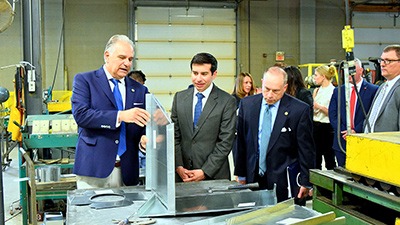
INDUSTRIAL: Lee Mechanical’s 250,000-Pound Sheet Metal Answer to the Data Center Boom The data center market doesn’t wait. Facilities feeding the infrastructure behind America’s explosive demand for computing power operate on relentless timelines, and when one of Lee Mechanical’s long-standing clients needed a major mechanical expansion at its southeastern Wisconsin facility, the Franklin-based contractor was ready“This has been a client of ours for quite a while,” says Ken Ahler, President of Lee Mechanical. That established trust mattered on a project of this scale and sensitivity. This was a 200,000-square-foot mechanical infrastructure expansion within an existing one-million-square-foot facility that was completed over roughly 10 months in 2024 for a company that sits upstream in the data center supply chain, providing products and systems that feed directly into the data centers being built across the country. [Per the client’s requirements, the facility and its operator remain unnamed.] The ScopeLee Mechanical was brought in as the design/build contractor working directly for the client, handling mechanical, plumbing, fire protection, controls, startup and commissioning, as well as general conditions management across the expansion. At the center of the project was a new chiller plant built to support 16 custom air handling units that modulate temperatures for 80 server test racks — systems where precise environmental control is a requirement.The chiller installation alone illustrated the scale of what the team was up against. Getting 52,000-pound chillers into position inside an existing facility isn’t a standard logistics problem. Lee’s team engineered a custom-fabricated equipment dolly specifically designed for the task. This mechanical infrastructure expansion project involved 52,000-pound chillers. Lee Mechanical custom-fabricated an equipment dolly to use to get each of them into place.By the time the job was complete, Lee’s team had installed approximately 250,000 pounds of sheet metal and logged 48,000 total work hours over the course of the project. More than 35 skilled tradespeople were on the job at peak, including sheet metal workers, steamfitters, plumbers, HVAC control technicians, sprinkler fitters and service technicians.“That’s a large project,” Ahler says when asked how 250,000 pounds of sheet metal compares to a typical industrial job in the region. Air Over LiquidWhat made this particular project distinctive within the data center world was its heavy reliance on air-cooled systems and, correspondingly, the sheer volume of sheet metal involved.Ahler is candid that the technology landscape is already shifting beneath the industry’s feet. “The data center market is shifting more to liquid-cooled technology,” he says. “At the time this project was done, air-cooled technology was still the predominant approach, but now we’re seeing a shift toward more piping-heavy projects.”For sheet metal contractors, that evolution is worth watching. Projects like this one where the cooling architecture drives a massive ductwork and air handling scope are becoming less common as liquid cooling gains ground. That makes this particular build something of a high-water mark for air-cooled data center infrastructure work.Working in Someone Else’s HouseThe technical scope was matched by a logistical one. The expansion took place inside a fully occupied, actively operating production facility, which meant every phase of the work had to be choreographed around the client’s own employees, schedules and daily operations.“Navigating major construction like this in anoccupied building poses challenges,” Ahler says. “Whether that’s coordinating shutdowns or managing employee traffic within the building, it required constant communication.”Lee’s project manager and on-site foreman held weekly planning meetings with the client; projecting two to three weeks ahead to identify which areas of the building required access; arrange for staff to be temporarily relocated; and ensure that egress throughout the facility to restrooms, cafeterias and work areas was never compromised.But the coordination went beyond schedules. It required a shift in jobsite culture. “We had to communicate to our team to keep in mind that we’re working in someone else’s house right now,” Ahler says. “We wanted to make sure they knew we weren’t just passing through. This meant reminding everyone to clean up after themselves and be professional. We’re guests.” A Market Reshaping Southeast WisconsinFor Lee Mechanical, the data center supply chain sector is a market that has meaningfully changed the company’s trajectory. Ahler says the segment has driven roughly 30% revenue growth over the past two years.“This particular market has definitely impacted us,” he says. “Something we’ve seen in the past two years — jumps in revenue and in size — impacted by this industry.”It’s a trend that shows no signs of slowing in Wisconsin. Microsoft began building data center infrastructure in the state three years ago, with projections that construction activity will continue through at least 2033. Multiple additional data center sites are currently under development across the region, and contractors with the workforce, relationships and technical depth to serve that market are well-positioned — provided they can adapt as the technology evolves.
by John Crowley | Jul 14, 2026 | Uncategorized
HVAC: Mapping the Work In many fabrication shops, the hardest part of improvement is seeing the work clearly. Jonathan Marsh’s case for AI started there. “If a process is vague, undocumented or trapped in someone’s head, the shop pays for it in rework, waiting and friction,” says the CEO of Steel Toe Consulting and a technology strategist who specializes in helping construction companies integrate and implement modern technology and workflows to enhance their operations. At SMACNA’s Fab Forum that took place in April in Chicago, he framed process mapping as a practical way to recover time and reduce wasted capacity, arguing that clear, standardized systems can improve throughput and profitability.AI can help smooth this process, he says. Instead of waiting for a perfect document or a dedicated process writer, teams can capture work as it happens and let AI help shape raw material into something usable. “That means,” he explains, “a supervisor, operator or frontline worker can contribute with little training, turning screenshots, phone videos, notes and existing documents into first drafts much faster than traditional documentation methods.”Start With Real WorkMarsh’s chronological approach begins with observation. Before AI can organize anything, the shop must show it what actually happens on the floor. He suggests a simple capture flow that starts with collecting the work in motion, whether through screen recordings, click trails, videos or notes, and treating those as the raw ingredients for later cleanup.The next step is normalization. AI can help turn a rough transcript or a pile of observations into a consistent structure by adding step formatting, naming conventions, role labels and safety notes. In other words, the tool is imposing order on the shop, so that a messy process becomes readable and repeatableMarsh identifies screen-based systems as especially useful for digital workflows, since they can automatically generate step-by-step standard operating procedures (SOPs) from software activity. For teams that need training and version control, he points to platforms that combine process documentation with onboarding and approval workflows.General-purpose large language models can be flexible options for fast drafting and formatting. “That flexibility matters when a team already has its own templates or wants to build a process from transcripts, notes or scratch,” he explains. “It’s not that one tool fits every shop, but that a tool matches the kind of work being documented.”Build the TeamMarsh argues that good process work depends on the right people, not just the right software.AI implementation works best when two roles are present: an innovation lead and a delivery lead. One person sees patterns, adapts quickly and pushes ideas forward; the other keeps the work sequenced, grounded and consistent.He ties that to personality and working style. The process improvement fails when it is either too theoretical or too rigid. “A strong team balances creativity with execution so the result is both practical and scalable,” he says.Process or ProcedureThere is a difference between process and procedure in AI adoption.A process describes the bigger flow of work: what happens, in what order and how one stage connects to the next. A procedure, by contrast, gets down to the exact steps, rules and checks needed when the task must be done the same way every time.Since not every job needs the same level of control, Marsh suggests using process language for larger workflows, such as project life cycles or shop flow,and procedure language for tightly controlled tasks like machine operation, fixed-station assembly or quality checks. “The wrong level of detail can make a system either too loose to be useful or too rigid to survive contact with reality,” he shares. From Video to SOPTo do this right, use a simple implementation method, Marsh suggests. First, identify the process or procedure and define its key areas. Next, film the work as it exists today, then review the video with people who understand the operation and create a descriptive transcript.From there, AI can turn that transcript into a draft SOP or process document, which should then be reviewed, approved and stored for reuse. He emphasizes that the final system should be searchable, versioned and organized so teams can return to it later instead of rebuilding knowledge from scratch.In the end, it’s “not about replacing human judgment,” he says. “It’s more about making expertise visible, reusable and easier to teach.”
by John Crowley | Jul 14, 2026 | Uncategorized
ARCHITECTURAL: 173 Feet Up, 130 Years In There are restoration projects, and then there are missions. The renewal of McGraw Tower at Cornell University fell squarely into the second category.Standing 173 feet above the Ithaca, New York campus, McGraw Tower has marked time since its completion in 1891. The clock tower, originally built as part of Cornell’s historic library complex, is one of the university’s most recognized landmarks. Its roof, replaced in 1932 with a lead-coated copper chevron pattern, had become as much a part of the building’s identity as the bells it houses. But after more than 130 years of exposure and decades of patches that slowed but never stopped persistent leaks, the roof had reached the end of its service life.The design team approved a full replacement, and its members hired Heather & Little to do the work, says Marc Jamieson, Vice President of Sales and Estimating at Heather & Little Limited, the Toronto-area architectural sheet metal firm that got the consulting work, followed by the renovation and construction.A Rare Material, A Rarer Skill SetHeather & Little hadn’t come to the project cold. The firm had been consulted early before the job went to bid when the design team was still working through material decisions and wasn’t yet fluent in what working with sheet lead actually requires.“They weren’t all that familiar with working with sheet lead,” Jamieson says. “So, we helped them come up with some design parameters.”The McGraw Tower has a distinctive chevron pattern made of sheet lead. That early consultation laid the groundwork for the decision that would define the project. Rather than replicating the original lead-coated copper, the design team chose sheet lead, a material with deep roots in historic preservation work and one that Heather & Little says it knows better than almost anyone in North America.Lead’s virtues for a project like this are well documented. It is resistant to corrosion, maintaining structural integrity across extreme temperatures, heavy snow loads and decades of freeze-thaw cycles. It develops a natural patina over time that suits historic structures aesthetically. It is fire-resistant. And, critically for McGraw Tower, it is soft enough to conform precisely to irregular substrates, which would prove essential given the tower’s geometry.But sheet lead is also, as Jamieson puts it plainly, “an unusual material to work with these days.” In the United States, health and safety concerns have made it increasingly rare on active job sites. In Canada, Heather & Little and a small number of peers still use it regularly with rigorous safety protocols, including periodic blood testing for workers handling it, built into standard practice. That institutional knowledge is precisely what Cornell’s design team needed and couldn’t source domestically.Built by Hand, Panel by PanelHeather & Little came on as a subcontractor to general contractor Welliver, and their scope was comprehensive: supply and install the full 6-pound sheet lead roofing system, replicating the tower’s distinctive chevron batten-seam design; install lead panels, battens, stainless steel fasteners, copper cleats, synthetic and fabric underlayments, welded connections, and all associated flashing components; and extend the work to the tower’s custom lead spire cap and eave assemblies — each fabricated to heritage specifications with seamless transitions and watertight joints.What made the execution genuinely unusual, even by restoration standards, was where the fabrication happened, which was not in a shop, but on site.“Most of it is fabricated in the field,” Jamieson says. “Lead is very soft, and it’s meant to conform very precisely to the substrate. It can’t bridge a gap the way regular sheet metal might. It must match exactly.”That means if one chevron panel sits at a slightly different angle than the one beside it — a near-certainty on a 130-year-old structure — each piece must be custom-formed to account for it. There is nothing production-oriented about the process. It is slow, deliberate and tactile work, shaped by the building itself rather than by shop drawings alone.The firm also produced detailed shop drawings, full-scale mock-ups of proposed roofing assemblies and thorough documentation of existing conditions before a single panel was installed — a process that allowed the design team to evaluate appearance, detailing and constructibility before committing to the final approach.The Logistics of Working Far From HomeExecuting this kind of work 500 miles from the firm’s home base added another layer of complexity. Heather & Little’s crew couldn’t pull additional materials from the shop on short notice, couldn’t easily send in support staff and had to operate with the self-sufficiency of a remote expedition.“Because of the distance and the fact that we were working remotely, we didn’t have access to the shop even if we could have,” Jamieson says. “You can’t just call up and order a couple of pieces of flashing.”The crew traveled from the Toronto area to Ithaca and worked on location for the duration of the project — a lengthy one, given the nature of the material and the precision required. The result, by all accounts, was worth the effort.“We’ve been in touch with the architect recently,” Jamieson says, “and they were very pleased with the end result.”What This Kind of Work RequiresMcGraw Tower isn’t an anomaly in Heather & Little’s portfolio. The firm has completed similarly demanding heritage metalwork on the Legislative Assembly of Ontario and other landmark structures across North America. Working in materials and methods that most of the industry has long since set aside keeps the company competitive in this space.The McGraw Tower “is an iconic, important part of the campus,” Jamieson says of the tower’s chevron roof. “You couldn’t just replace it with something else. It had to be like materials and like design.”Heather & Little made sure it was.
by John Crowley | Jul 14, 2026 | Uncategorized
Two Cities. One Mission. There’s a reason the most effective professional development doesn’t happen on a webinar. Surveys consistently show that in-person events drive deeper learning, stronger peer relationships and greater long-term engagement than their virtual counterparts. The construction industry is no exception. According to a Bizzabo survey, 76.6% of organizers consider in-person conferences critical to their organization’s overall success, and research from Oxford Economics has found that every dollar invested in face-to-face business meetings returns $12.50 in value.SMACNA is putting those numbers to work.In the spring of 2026, the association brought its members together in two very different rooms for two very different reasons, and both mattered. In Chicago, the 2026 SMACNA Fabrication Forum drew a sold-out crowd of contractors, technologists and industry leaders to the shop floor of one of the Midwest’s most innovative mechanical firms for two-and-a-half days of hard-nosed sessions on prefab, automation, materials management and the systems that separate efficient shops from struggling ones. Meanwhile, in Washington, D.C., SMACNA convened its first-ever Leadership Conference, a two-day immersion in the legislative realities facing the sheet metal and HVAC industries, including tariffs, pensions, tax incentives and the art of making lawmakers listen.Different cities and different agendas, but with the same underlying conviction: when contractors show up, share what they know and engage with the world beyond their own shop or chapter, the entire industry moves forward.What follows is a look inside both events and the work being done to sharpen the people who keep the sheet metal industry running.
by John Crowley | May 18, 2026 | Uncategorized
AI Is Your New Apprentice: Why Contractors Need Training, Guardrails and an AI Game Plan in 2026 AI TECHNOLOGYAt its heart, artificial intelligence differs from traditional software because it uses probability, not instructions, to get work done. This gives it enormous power to handle real world inputs, without requiring expensive reformatting and collection. But it also means that outputs are not automatically reliable.We address this by engineering AI systems that surround the core AI models with guardrails. Think of AI like a smart but inexperienced worker. It can read fast, write fast and find things fast, but it needs supervision and clear direction, just like a green apprentice.AI RISKSLeaders should consider six main risks as they assess AI strategy and implementation:Security: AI systems are not inherently prone to cybersecurity risk than other cloud software. An AI model will not remember what it has worked on, contrary to popular misconception. However, AI has unique risks, because we are exposing our software to more of the real world than traditional software. The biggest concern amongst cybersecurity specialists is “prompt injection,” which means the AI is exposed to malicious instructions because of a document, website or other source that tells it to do unwanted things.
Mitigation: Ensure the IT department is trained and aware of AI-specific risks and recommends and enforces policies to avoid them. This should not be a heavy lift but needs to be ongoing as new risks evolve.Agentic control: The power of AI agents is that they develop their own plans and execute them. But, just like a human, they can go off track. This can become problematic because it wastes time and resources. Also, whenever you give an agent access to tools and resources, it can do things you’d prefer it not, like delete or alter files.
Mitigation: Ensure extensive testing, strict permissioning and periodic testing. Easy Button: Workers trust AI because it sounds confident and looks polished, but it can lead to over-reliance on a tool that still makes mistakes..
Mitigation: Treat AI training the same way you’d treat safety training. Essential, non-negotiable and ongoing. Basic training on how to use AI well is not expensive and does not need to be extensive. Part of this training should be in-person groups, where coworkers learn from each other. Overwhelm: In an industry with long hours and stressful days, AI presents another challenge: burying people in information faster than they can process it.
Mitigation: Train workers how to think about integrating AI into their work and how to effectively instruct AI. Long, overdone answers are not inevitable, and brief training can make them both aware of the problem and how to get the right number of inputs.Overautomation: More than one AI vendor is promising automation of key workflows. This sounds attractive, but there is a reason experienced workers do certain things. Good AI solutions maximize context and opportunity for workers to apply judgment and creativity where needed, while automating the supporting functions that make judgment possible. EDITOR’S NOTE: For March/April and May/June, I am honored to cede my article space to SMACNA’s AI Leadership consultant, Hugh Seaton. Hugh has been providing valuable insights, webinars and thought leadership to our members over the last two years. Visit SMACNA’s Construction Technology & AI site (www.smacna.org/business-resources/business-management/construction-technology-ai) to learn more about the topic. This is part one of two.