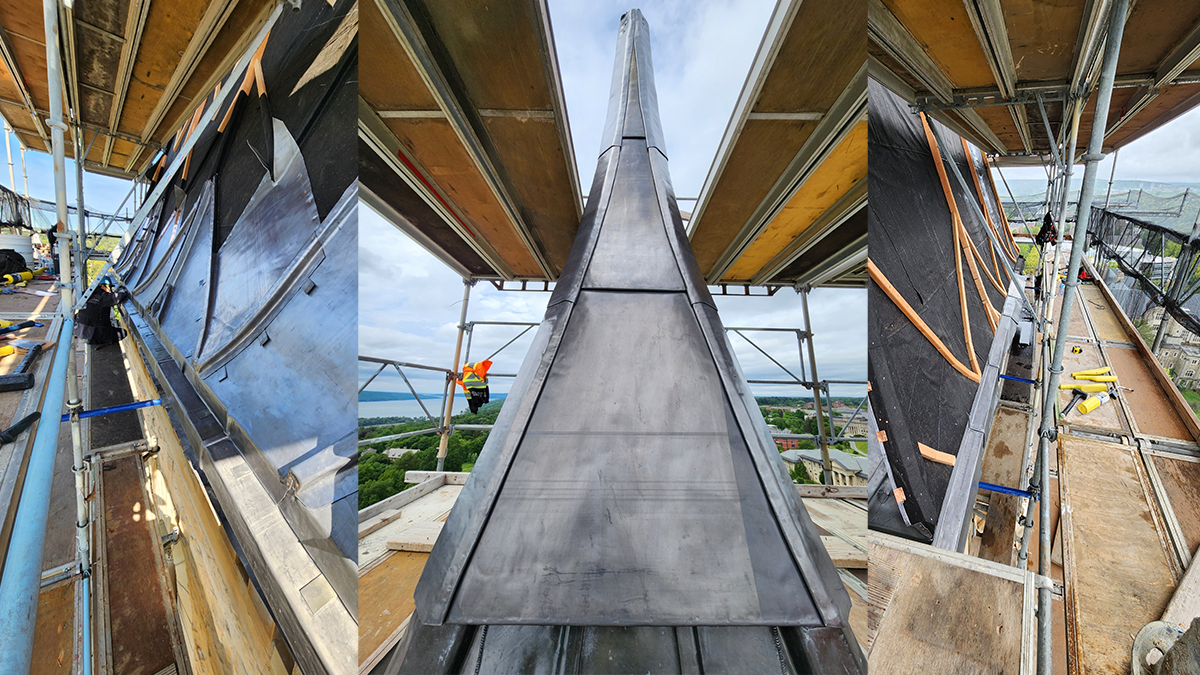
 There are restoration projects, and then there are missions. The renewal of McGraw Tower at Cornell University fell squarely into the second category.
Standing 173 feet above the Ithaca, New York campus, McGraw Tower has marked time since its completion in 1891. The clock tower, originally built as part of Cornell’s historic library complex, is one of the university’s most recognized landmarks. Its roof, replaced in 1932 with a lead-coated copper chevron pattern, had become as much a part of the building’s identity as the bells it houses. But after more than 130 years of exposure and decades of patches that slowed but never stopped persistent leaks, the roof had reached the end of its service life.
The design team approved a full replacement, and its members hired Heather & Little to do the work, says Marc Jamieson, Vice President of Sales and Estimating at Heather & Little Limited, the Toronto-area architectural sheet metal firm that got the consulting work, followed by the renovation and construction.
A Rare Material, A Rarer Skill Set
Heather & Little hadn’t come to the project cold. The firm had been consulted early before the job went to bid when the design team was still working through material decisions and wasn’t yet fluent in what working with sheet lead actually requires.
“They weren’t all that familiar with working with sheet lead,” Jamieson says. “So, we helped them come up with some design parameters.”
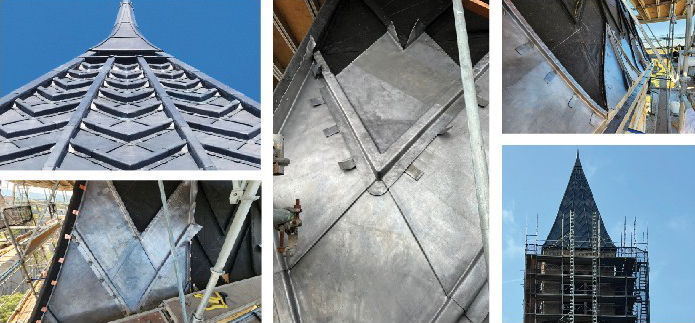
The McGraw Tower has a distinctive chevron pattern made of sheet lead.
That early consultation laid the groundwork for the decision that would define the project. Rather than replicating the original lead-coated copper, the design team chose sheet lead, a material with deep roots in historic preservation work and one that Heather & Little says it knows better than almost anyone in North America.
Lead’s virtues for a project like this are well documented. It is resistant to corrosion, maintaining structural integrity across extreme temperatures, heavy snow loads and decades of freeze-thaw cycles. It develops a natural patina over time that suits historic structures aesthetically. It is fire-resistant. And, critically for McGraw Tower, it is soft enough to conform precisely to irregular substrates, which would prove essential given the tower’s geometry.
But sheet lead is also, as Jamieson puts it plainly, “an unusual material to work with these days.” In the United States, health and safety concerns have made it increasingly rare on active job sites. In Canada, Heather & Little and a small number of peers still use it regularly with rigorous safety protocols, including periodic blood testing for workers handling it, built into standard practice. That institutional knowledge is precisely what Cornell’s design team needed and couldn’t source domestically.
Built by Hand, Panel by Panel
What made the execution genuinely unusual, even by restoration standards, was where the fabrication happened, which was not in a shop, but on site.
“Most of it is fabricated in the field,” Jamieson says. “Lead is very soft, and it’s meant to conform very precisely to the substrate. It can’t bridge a gap the way regular sheet metal might. It must match exactly.”
The firm also produced detailed shop drawings, full-scale mock-ups of proposed roofing assemblies and thorough documentation of existing conditions before a single panel was installed — a process that allowed the design team to evaluate appearance, detailing and constructibility before committing to the final approach.
The Logistics of Working Far From Home
Executing this kind of work 500 miles from the firm’s home base added another layer of complexity. Heather & Little’s crew couldn’t pull additional materials from the shop on short notice, couldn’t easily send in support staff and had to operate with the self-sufficiency of a remote expedition.
“Because of the distance and the fact that we were working remotely, we didn’t have access to the shop even if we could have,” Jamieson says. “You can’t just call up and order a couple of pieces of flashing.”
“We’ve been in touch with the architect recently,” Jamieson says, “and they were very pleased with the end result.”
What This Kind of Work Requires