by John Crowley | Mar 9, 2026 | Uncategorized
The Infrastructure Work Pipeline When Sabrina Sussman talks about transportation, she does not start with lanes, bridges or budgets. She starts with people trying to get to school, work or a doctor’s appointment and what happens when they can’t. In a SMACNA webinar with Seth Lennon, SMACNA’s Director of Content Development and Media Relations Policy, Sussman explains that she “fell in love with transportation” only after stumbling into a job at the U.S. Department of Transportation and realizing “it doesn’t matter what you’ve built if people can’t get there.”Now, as Chief Program Officer for Nashville’s “Choose How You Move” initiative, Sussman oversees a $3.1 billion, 15-year, voter-approved program to overhaul sidewalks, bus service, corridors and traffic signals across one of the fastest growing metros in the country. The work is infrastructure on paper, but in practice, it is a massive pipeline of projects that will require the skills of sheet metal and HVAC contractors in transit facilities, control centers and dense urban corridors for years to come.From Accidental Transport Nerd to Nashville CPOSussman never planned a career in transportation. She moved to Washington, D.C., wanting to work in government on health or education policy and took a position at USDOT, telling herself, “government’s government, you can always pivot.” Instead, she stayed — twice. Early roles at USDOT, a stint in New York City Hall and time at Zipcar gave her a front row seat to how cities and the private sector share responsibility for how people move.Most recently, she served as chief of staff and deputy to U.S. Deputy Transportation Secretary Polly Trottenberg, and as a senior adviser to then Secretary Pete Buttigieg, working on the rollout of the Bipartisan Infrastructure Law and a wave of federal investments in roads, bridges, airports and transit. “You go where the money is when it comes to infrastructure,” she says, noting that the law marked a “generational investment” after decades of underfunding. For contractors, that shift at the federal level is now being echoed — and in some ways amplified — by cities and regions that are self-taxing to build their own projects.Inside “Choose How You Move”Nashville’s turning point came in 2024, when 66% of voters approved a half-penny sales tax dedicated solely to transportation. Under Tennessee law, localities that want big infrastructure must largely “self fund,” so the city put a detailed Transportation Improvement Program (TIP) on the ballot, promising specific projects in exchange for that tax.“It was a $3.1-billion program over 15 years,” Sussman says. “It includes 86 miles of sidewalk, nearly 600 traffic intersection signals and 10 all access corridors” — the heaviest, most congested corridors in the region — with safety improvements woven throughout. Every block and intersection is identified on a public map, giving contractors an atypical level of certainty about where work will be and what will be built.One year after the referendum passed, Sussman cut the first ribbon, marking the completion of an early “quick win” project: a transit signal upgrade called a queue jump that lets buses enter the intersection a few seconds before cars, so routes move faster. At the same time, her team is launching short-, medium- and long-term work: signal replacements and fiber in the near term, and full corridor redesigns and large sidewalk packages in later phases. For mechanical and sheet metal firms, those “all access corridors” and transit enhancements mean future work tied to stations, shelters, operations centers and high performance systems in buildings along those routes.Potholes are Nonpartisan, and So is the WorkIf there is a theme to Sussman’s message, it is that transportation is fundamentally local and fundamentally bipartisan. She jokes that one of her favorite conference ribbons reads “potholes are nonpartisan,” because “when people drive down the street or are at the airport, it doesn’t matter who’s in power; what matters is that their infrastructure needs help and support.”She believes that local leaders are now wrestling with the same questions Washington faced during the infrastructure law debate: “How do we fund infrastructure investments?” and “Have those networks that supported our prosperity kept up with the growth?” Cities like Nashville, Charlotte, Columbus and Austin are answering by asking voters directly to approve transportation referendums, and they’re often succeeding. For SMACNA contractors, that means the next boom in work may not just follow federal megaprojects; it will track these local “self-subscribed” programs where the money and project lists are set for a decade or more.Where contractors come in is to fill the capacity gap. “Nashville and Middle Tennessee don’t have all the people that we need to pull this off,” Sussman says. She calls “Choose How You Move” not just a transportation program but “also a workforce development program,” adding that the city needs contractors to “be welcoming and inventive and encourage new folks to come to town” to help deliver the work.Her tips for SMACNA members are direct: Track which localities are pushing big infrastructure packages; that is where the work and funding will be.Be “good, trusting partners” who help cities deliver projects faster, not just cheaper.Offer ideas that cut red tape and timelines without sacrificing quality because “the best way to ensure that public investment continues is to deliver.”She describes one example from Nashville where a contractor pointed out that restrictive city rules allowed only six working hours a day on certain sites, dramatically slowing completion. “If we’re only allowed to work on a job site for six hours a day, it’s going to take a really long time,” the contractor told her, prompting a rethink about longer hours and trade-offs between short term disruption and faster delivery. For mechanical contractors used to carefully phased shutdowns and tight commissioning windows, that kind of honest feedback is exactly where they can add value.Why This Matters for HVAC and Sheet Metal ProsWhile much of Sussman’s story centers on sidewalks and signals, she stresses that transportation projects are not one-and-done; they are systems that must be built, operated, maintained and continuously upgraded. “Transportation and infrastructure are not about build it once and move on,” she says. “You have to build it, operate it and maintain it. Those investments take work over many years.”That long tail of work touches SMACNA contractors at multiple points: Airports and terminals. Aging terminals designed for a pre-9/11 world are being rebuilt to handle new security, passenger flows and energy performance standards — from Kansas City’s complete terminal replacement to expansions at Nashville’s BNA. Those projects require complex HVAC, high-end architectural sheet metal and advanced controls.Transit and corridor facilities. Bus rapid transit lanes, stations, depots and signal houses are all mechanically intensive spaces where reliable, efficient systems are critical to uptime and safety.Operations centers and data infrastructure. As Sussman notes, many of Nashville’s traffic signals are 50 to 60 years old and untouched; upgrading them means new equipment, new rooms to house that equipment and reliable cooling and ventilation for electronics and staff.She underscores that much of this work is now technology driven, whether in signal systems, data collection or facilities that must support continuous operations. “It’s weird to think about roads as tech projects, but they are in a lot of ways,” she says, noting that while people replace phones every 15 months, many cities are still running traffic control hardware from the 1960s. For contractors comfortable integrating building systems with digital infrastructure, that shift plays to their strengths.Where Contractors Can Shape the PipelineSussman repeatedly returns to the role of labor and contractors in getting “Choose How You Move” across the finish line. An outside campaign backed by advocates and unions helped make the case to voters that Nashville’s congestion, which Forbes labeled “the worst commute in the country,” wasn’t inevitable and could be fixed with a dedicated investment.She encourages SMACNA members to replicate that model elsewhere:If your city is even “pondering” a transportation referendum, “jump in, offer to help and ask them how you can really help make that case,” she says.Be honest that these programs provide both desperately needed infrastructure and “jobs for your members,” and explain that clearly to the public.Engage at every level — federal, state and local — because “it’s not just one flavor of advocacy that gets those jobs done.”Her advice to a contractor eyeing opportunities in places like Boston’s MBTA repairs or airport expansions is practical: monitor FAA passenger data to see which airports are growing fastest, watch for big capital announcements (such as BNA’s recent $4-billion expansion plan) and proactively meet with owners to understand schedules and procurement paths.Looking ahead, Sussman sees a future where “all of the above” is the only realistic answer: more capital investment, more maintenance, more retrofits and more experimentation with new modes and technology. Cities that have expanded transit networks once like Seattle are now passing subsequent measures to operate, maintain and improve what they already built.Her deputy in Nashville talks about “continuous improvement” or going back to corridors as technology and use patterns change instead of treating them as finished forever. That mindset mirrors where many leading HVAC and sheet metal firms already are as long-term partners across a facility’s life cycle, not just low-bid installers.For HVAC and sheet metal companies, Sussman’s message is both a challenge and an invitation. Transportation is becoming more local, more voter driven, more tech heavy and more dependent on contractors who can deliver complex work quickly while protecting public trust. “Cities are doing some tough work,” she says. “Go to them and ask them if you can help be a part of that.”
by John Crowley | Mar 9, 2026 | Uncategorized
RESIDENTIAL: Boost Your Residential HVAC Business with Social Media In today’s digital age, residential HVAC contractors face a new imperative: mastering social media. Cody Shook, Director of Social Media for SMACNA National, shared insightful strategies at the 2025 SMACNA Annual Convention in Maui to help HVAC businesses harness this powerful tool.“Social media isn’t just a trend. It’s a catalyst for real business growth,” Shook says. “When done right, it builds brand trust, generates leads and keeps your company top of mind in clients’ communities.” Shook offered these seven tips for social media success. Know Your Starting Point. Shook outlined three typical social media stages for HVAC companies: those without any presence, those struggling to launch effectively and those already seeing success who want to maintain momentum. “It’s critical to identify where your company falls, so you can tailor your approach,” he advises.Prioritize the Right Platforms. For residential HVAC contractors, Shook highlighted the importance of focusing on priority platforms like TikTok, Instagram and LinkedIn. “Each platform has a unique audience and vibe,” he says. “TikTok is great for short, engaging videos that show your work and personality. Instagram helps showcase visuals and stories. LinkedIn is ideal for professional partnerships and building authority.”Consistency Is Key. When asked about posting frequency, Shook shared data-backed best times and recommended cadence. “Aim for nine to 18 posts a week distributed across platforms,” he says. “Post when your audience is most active. For example, Instagram followers peak on weekends from 10 a.m. to noon.”Use Smart Tools. To manage content efficiently, Shook recommends tools like Hootsuite for scheduling and analytics, CapCut for captioned videos and Canva to create eye-catching graphics. “You don’t have to do everything manually,” he explains. “Automating posts and tracking results makes a huge difference for busy contractors.”Content That Connects. Residential HVAC customers relate to authentic stories and helpful information. Shook encourages showing behind-the-scenes work, spotlighting team members, promoting safety practices and celebrating milestones. For instance, sharing a quick video of an apprentice mastering a welding station not only humanizes your brand but also celebrates your commitment to craftsmanship.Engage Positively, Always. “How you react publicly to posts can define your company’s reputation,” Shook explains. Use upbeat, community-focused comments when engaging with partners or clients. Avoid negative interactions, even when tempted. Turning customer feedback into a positive story is a win-win.Own Your Story Beyond the Post. Shook reminds contractors that “your story doesn’t end when you hit ‘post.’” Follow up on engagement, reshare collaborator content and leverage SMACNA’s PR resources for larger media pushes. “Social media success is about sustained conversation and genuine connection,” he stresses.Why Social Media Is Worth Your TimeCiting studies, Shook shared compelling reasons to invest in digital presence. “Over 70% of consumers who experience a brand positively on social media are likely to recommend it,” he says. “Nearly two-thirds of homeowners search online before hiring a contractor, and many trust online reviews as much as personal referrals.”And when it comes to your time and resources, Shook sums it up, plainly. “Don’t think you’re too busy for social media. People spend almost five hours a day on their phones; your next customer could be just a post away.”For residential HVAC contractors ready to grow their businesses, leveraging smart social media strategies is essential. As Shook explains, taking the first step with authentic content, consistent engagement and smart tools lays the foundation for long-term success in an increasingly digital marketplace.
by John Crowley | Mar 9, 2026 | Uncategorized
INDUSTRIAL: Rethinking Project Management Project management systems are becoming mission-critical infrastructure for industrial sheet metal and HVAC contractors because the complexity, risk and speed of today’s work have outgrown spreadsheets and paper.When does manual job tracking become a liability? When costs and quality problems escalate, meetings expose problems, and claims and change orders rise. Unfortunately, construction has historically lagged other industries in digital adoption, with a significant share of contractors still relying on spreadsheets, whiteboards and paper-based workflows for planning and tracking. But adoption is accelerating under pressure from tighter margins, more complex projects and workforce shortages.Graham Corsar, who was previously a Project Manager but now works with contractors as an Account Executive at Trimble Inc., a construction technology company, argues that the real question isn’t whether you “need a project management tool,” but whether your existing system can survive as industrial work continues advancing.One Mistake Could Eliminate Your Profit Margin On a multi-million-dollar industrial job, an HVAC or sheet metal contractor is often living on a 5% to 10% margin, where $50,000 to $100,000 can vanish with one mistake: one missed change order, one shop error, a misread spec, late material or a crew installing from the wrong drawing.Industrial work magnifies that risk. Large air handlers, extensive duct runs, specialty metals and complex supports mean material is a major cost driver, and much of it is ordered early, long before the last RFI is resolved. Add in aggressive schedules, tightly sequenced trades and code inspections that can shut down a floor, and a contractor’s financial outcome is inseparable from how projects are planned, tracked and documented day to day.For many industrial shops, the system is a patchwork: estimating software feeding into Excel, hand-marked shop tickets, email chains and shared drives. “Your company already is the project management system,” Corsar argues.Corsar breaks that system into three elements — people, processes and tools — and insists that software sits firmly in last place.People: project managers, coordinators, detailers, foremen, fabricators and their experience, judgment and willingness to communicate bad news early.Processes: how change orders are captured, how RFIs are logged and answered, how drawings are issued and superseded, how labor is tracked and compared against budget.Tools: the actual platforms that hold drawings, budgets, time sheets, RFIs, submittals and photos.“A new platform that just recreates the same bad habits in the cloud will not save a single dollar of margin,” he insists.When Manual Tracking Becomes a LiabilityThe contractors who most urgently need a structured project management system often have the most reason to believe they can get by without one. The crews are seasoned, the estimator knows the market and the shop has its own rhythm. But Corsar asks them to look for three warning signs that show they can no longer operate without a better system:Too many surprises. Costs, quality problems, schedule slips or scope gaps keep blindsiding the project team. This equates to project managers being surprised more than once a week, executives more than once a month and ownership more than once a quarter, Corsar says, signaling that the system isn’t surfacing risk early enough.Progress reports that require a meeting. In many sheet metal shops, job status still comes together in a monthly ritual: someone gathers timecards, pulls the latest PO log, requests updated fabrication status, hunts through email for change approvals and then walks it all into a conference room. If there are no automated reports or dashboards, you are using meetings “to find out about problems, not to solve them,” Corsar says. Claims and change orders that leak value. If the value of missed or incomplete claims is more than 25% of your margin or if no one can say how much is missing, the contractor is effectively donating profit to the general contractor or owner. In industrial HVAC work, where scope creep often hides in “small” extra runs or rework tied to other trades, that leakage can define an entire year’s results.When all three indicators show up on the same jobs, Corsar says the problem is not “bad luck;” it is the project management system itself, and spreadsheets are part of the problem.Who Actually Needs Project Management Software?Corsar doesn’t pretend every contractor needs a heavyweight project management platform tomorrow. Instead, he challenges firms to ask what they are really trying to fix and to focus first on process. An integrated project management system can force changes through one documented path: an RFI or change request is logged, the model or drawing is updated, the shop status is changed, new assemblies are tagged and the cost and schedule impact are attached to that specific event. That is how a contractor turns what used to be unbilled chaos into a billable, defensible change.For very small shops — fewer than 10 people — the question is stability. If jobs are small, scopes simple and changes rare, a modest digital backbone paired with disciplined processes may be enough. But if even one or two industrial scale jobs a year can push the company to the edge with complex coordination, multiple vendors and long lead times, that is a sign that more structured project management is no longer optional; it is insurance.For mid-sized contractors — those with multiple foremen, a dedicated project manager or two and a real backlog — the tipping points are usually:Repeated disputes over extra work, especially when documentation lives in texts and unsaved photos.Chronic re entry of data from field to office — time sheets, quantities, change logs — that burns out staff and still produces inconsistent numbers.Difficulty answering basic questions in real time: Where is this job versus budget? Which change orders are approved? How much labor have we really spent on this level?For larger firms, Corsar argues, the question is not, “Do we need a project management system?” but “Is the one we have working like it should?” Overhead (office salaries, software, infrastructure and the unplanned costs of rework and missed claims) is already functioning as project management spend; the only choice is whether that spend produces visibility and control or just more noise.How to Decide on Project Management System SoftwareWhen a contractor decides that “something has to change,” Corsar’s advice is to focus on four areas to keep the project management software decision grounded. Budget. This means understanding not just license fees, but what you already spend on people who are doing manual project management: tracking hours, copying data, chasing signatures, reentering quantities and fixing billing errors. That cost often dwarfs the software line item.Authority. Who really decides what project management tool can work best for the company? For a sheet metal contractor, that may mean bringing in the shop superintendent and the most skeptical field foreman before any contract is signed.Need. Are you shopping for cost control, productivity, decision speed or risk management? If the “need cannot be explained in a single sentence that makes sense to the ultimate decision maker,” he warns, “you probably aren’t clear on what you’re buying.”Timing. “System change takes 12 to 24 months,” Corsar says, and contractors should not let anyone convince them it can be done faster. For industrial HVAC and sheet metal shops juggling live jobs, that means planning a rollout that respects bid seasons, shutdown windows and critical project milestones.Processes First, Tools SecondCorsar’s most practical advice to industrial contractors is also the least glamorous: fix your processes before you pick your platform. He stresses that “good process can make up for shortcomings in tools & people,” and warns, “if you don’t have good processes, stop” before you sign any software contract.That might mean standardizing how markups become formal change orders with a clear path from foreman sketch to priced, approved scope. It might also mean defining a single source of truth for drawings and models, so no crew is ever building off an obsolete PDF taped to a gang box. And it could even mean setting a consistent way to tie labor and material codes back to estimating templates, so job cost feedback improves future bids.Only once those processes are clear does the choice of tool become meaningful. Industrial HVAC and sheet metal contractors do not need “another project management tool” so much as they need a system that lets their people see risk early, defend their work and protect the thin slice of margin that keeps the shop lights on. As Corsar says, “The software is only the part you can install; the rest is the company you are willing to change.”
by John Crowley | Mar 6, 2026 | Uncategorized
Meet SMACNA’s New President Todd Hill As the newly installed president of SMACNA for 2026, Hill brings a lifetime of grit, from a post-Christmas apprenticeship dare to steering Ventcon Inc. through multimillion-dollar expansions and a pivotal acquisition. His story resonates with SMACNA members, a blueprint for turning challenges into opportunities in a trade demanding both muscle and vision.From Boyhood Spark to Ventcon’s Bold Evolution Picture a young Hill, mesmerized by his father’s creations: a diamond-plate snowboard gleaming under workshop lights, crafted from scraps of sheet metal.“My dad was in the trade for 43 years,” Hill recalls, his voice reflecting the warmth of those memories. “I remember as a kid my dad would bring home different things that he would make or I would need, and it would come back as a piece of sheet metal.“But I never really understood what my dad did until after high school,” he adds. Hill was eyeing computer-aided design (CAD) or engineering when his father challenged him to take the apprenticeship test, and that changed everything. After acing it, he reported to Ventcon on Dec. 26, 1990. “I’ve been there from day one of my apprenticeship. Dec. 26th [2025] was 35 years,” he says. “It’s been a great ride.” While working at Ventcon, he earned his associate’s degree in applied science in CAD and mechanical design from Schoolcraft College in Livonia, Michigan. Hill climbed from apprentice to CAD operator and advanced through several management positions, becoming president in 2005. Then in 2010, Hill and partners, Scott M. Smith and Dennis T. Monaghan, bought out the previous owners of Ventcon Inc., turbocharging growth amid retiring leaders and booming demand. Facing equipment obsolescence in 2019, the company invested $1.5 million into Mestek Machinery, including lasers, coil lines and waterjet tables to help advance the business, Hill notes. It took about three months from start to finish to settle the new equipment into Ventcon’s shop workflow. Since then, operations have flowed and the company continued growth.Serving clients like Ford, GM, Stellantis, the University of Michigan and Pfizer, the firm logs top union hours in Wayne County with 140 workers. A Jackson, Tennessee, facility followed in 2022 for Ford’s megaprojects, and in 2023, Gallagher-Kaiser acquired a majority stake in the company, eyeing battery plants and data centers.Climbing SMACNA’s Ranks Hill’s ascent at SMACNA mirrors Ventcon’s growth. He started serving on local SMACNA Detroit boards involving pensions and apprenticeships and then moved on to national roles on HVAC councils, research institutes and green building task forces. Elected to the Executive Committee and crowned President in November 2025, he views the network as profound. “You end up meeting people in the industry, and before you know it, they become your best friends,” he shares, eyes alight. “My wife, Tammy, and I have met so many people in the industry from coast to coast.”Energized at the podium, Hill outlines 2026 priorities echoing his life’s pivot points. He is optimistic for explosive growth, not just for Ventcon but industrywide.“My company has seen a lot of expansion. I want to continue the path and continue to find the best talent we can — from the office staff through the union — and just make sure we have the best talent for the next generation and to promote our industry,” he says, targeting apprentices for generations ahead. “Our main challenge has been a shortage of jobsite leadership. Numerous leadership retirements and company growth have both contributed to this. The good news is we have had great success with the newer apprentices we have employed, and things look promising for the future.”Dismissing construction’s old stigmas, he champions future career paths. “There are so many opportunities right now for people who want to work with their hands,” he says. “It’s unlimited, and we’ve got to just continue to promote that.” Collaboration with SMART’s Mike Coleman amplifies this. “They’re on the same page as we are,” Hill says. “We don’t agree on everything 100%, but I think we have the same goals as far as finding talent. It’s all for the good of our union, our industry and sheet metal workers.”New committee voices will spark innovation, much like Hill’s machinery bets fueled Ventcon.Hill’s path — from his dad’s workshop to SMACNA president — equips him uniquely for SMACNA’s crossroads. His triumphs over labor gaps via apprenticeships, tech infusions and bold partnerships offer a roadmap for members navigating retirements, megaprojects and talent wars. As he reflects, “It’s been an amazing ride.”
by John Crowley | Mar 6, 2026 | Uncategorized
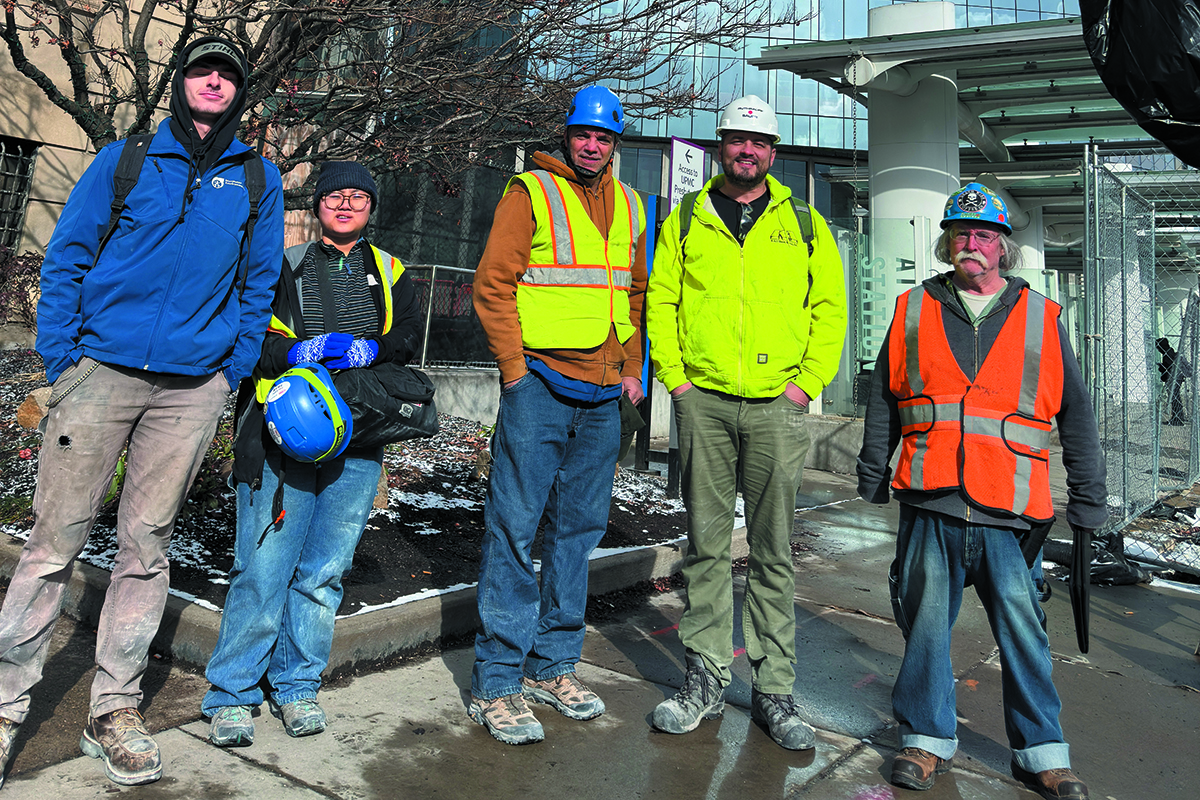
TESTING ADJUSTING AND BALANCING: Certifying Medical-Grade HVACPerformance in a New Hospital Tower Before it can open to the public in early 2027, the HVAC systems in the $1.3 billion UPMC Presbyterian hospital tower have to meet stringent performance specifications. Validating the airflow, pressure and hydronics equipment throughout its 900,000 square feet is the job of testing, adjusting and balancing contractor Northstar Environmental Ltd. The hospital-grade HVAC system is designed to meet ventilation and pressurization standards that support infection-control protocols for patients and staff.Northstar Environmental, based in Cranberry Township, Pennsylvania, is a member of SMACNA of Western PA and the Women’s Business Enterprise National Council (WBENC). The company has been involved in TAB work for more than three decades. Its portfolio includes major universities, hospitals and office buildings. Company Vice President Donald Leishman is a Testing, Adjusting and Balancing Bureau (TABB)-certified professional and the Co-owner of Northstar with his wife, Angela. The tower’s HVAC installation is being supervised by the MARS joint venture involving officials from two area mechanical contractors: McKamish and Ruthrauff-Sauer, both SMACNA members. Certified PerformanceLeishman says preparing to work on the hospital tower project was a multiyear process that started before the company won the work in a competitive bid. “We were working hand-in-hand with (the general contractors) to really solidify what was going to be needed from the TAB aspect of it,” Leishman says. “For a good two years, we did monthly meetings where we were trying to break down and make sure that we had discussed the specifications for this project.”TABB Supervisor John Kukonik calculates design pressure drops for Nexus Venturi valves while second-year Apprentice Eh Ta Mwe Paw connects the balancing valve. Chris Burgman, a first-year Apprentice, makes adjustments to the Nexus Venturi balancing valves that are installed in the UPMC tower expansion. The 17-story, $1.3 billion UPMC Presbyterian hospital tower expansion in Pittsburgh is scheduled to open in early 2027. SMACNA members involved in the project include mechanical contractors McKamish and Ruthrauff-Sauer and Northstar Environmental Ltd., a testing, adjusting and balancing company. Northstar Environmental was awarded the project in January 2024. UPMC facilities are regular clients, Leishman says. “We do a lot of the work in the existing Presbyterian hospital,” he says, “including their yearly air changes. So, we’re very familiar with the hospital itself and their crew. And I think that played a big part in why we were awarded this project.”As with most hospital HVAC projects, Northstar’s contract called for the company to ensure every room had the correct number of air changes per hour and was within 10% of design specifications on air and hydronic (water) flow. Northstar workers are setting up air handling units (AHUs) and pumps, checking all of the hydronic system’s Venturi values, variable-air-volume (VAV) boxes and that diffusers and grilles are within tolerances. “When we get to the ORs (operating rooms) and pharmacy areas, we have to make sure that we’re within design tolerances and pressurization requirements,” he adds. “And we’re doing the stairwell pressurization and fire-life safety work as well. And we have to make sure doors are operating properly — stuff like that. We are also a TABB-certified fire life safety contractor and will be responsible for work such as stairwell pressurization testing.”On Schedule As the hospital gets close to opening, a commissioning agent who works for the hospital system will inspect and certify Northstar’s work. Leishman expects his company’s work to be finished by the end of year, in time for the scheduled opening Jan. 24, 2027. “It’s a very large project and a lot of people have to finish their work before we get into our work. It’s been a team effort from everybody involved trying to get it ready to go,” he says. Leishman also credits Harold “Harry” Bolette, Northstar’s on-site supervisor, for the project’s success. Bolette brought over 40 years of testing, adjusting and balancing experience to the project. More than two years since starting work, the project has been smooth — “Knock on wood,” he says — with few hiccups or problems. Although he acknowledges that no matter how well an HVAC system is designed or installed, there are always tweaks that need to be made to differential set points, static pressure set points and other systems. But Leishman adds that he really enjoys his work. “It’s something new every day, something challenging,” he says of TAB work. “It’s not just installation. It’s problem solving. We do a lot with engineers and it’s nice to be able to work through the problem from the standpoint of drawings to installation to finalization and make sure that everything’s working properly — from the drawing table to the final product.”