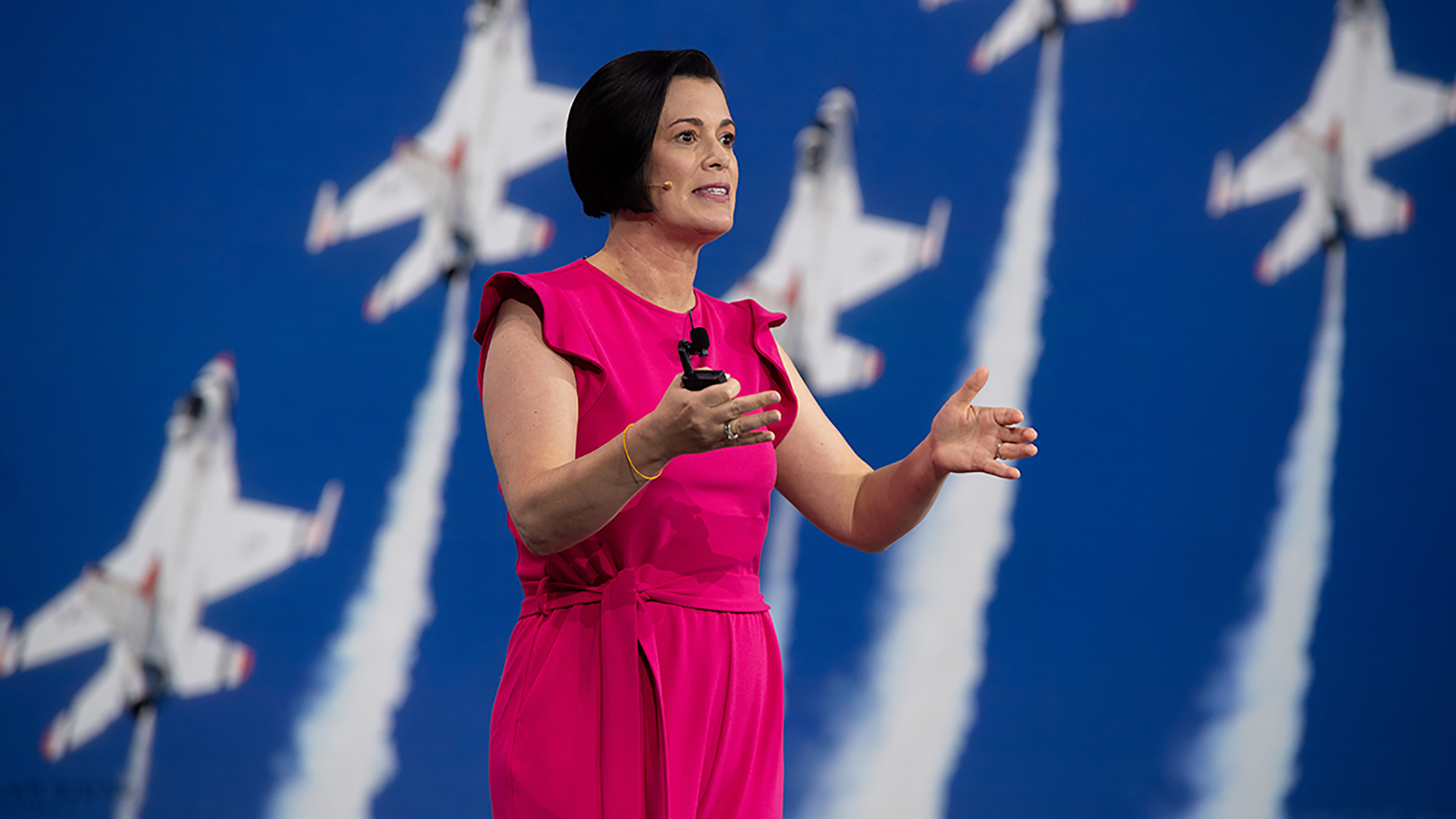
 As a child in Santa Maria, California, Nicole Malachowski’s fascination with aviation began after she saw an airshow.
“Sometimes I wonder if it’s weird that I declared at age 5 I wanted to be a pilot, and it actually happened,” says the USAF Retired Colonel, her tone equal parts humility and steel. That relentless drive shaped her youth: soloing in a Cessna at 16, then earning her Air Force commission. “People looked at me and said there’s no way I’d become a fighter pilot; it was against the law for women then. I found that made the dream more intriguing,” she says.
As one of the first women to fly the F-15E in combat and the first woman Thunderbird pilot, Malachowski later led a squadron, flew 2,300-plus hours and 188 in combat, and managed resources exceeding $1 billion.
So, when she takes the stage to speak, audiences expect tales of high-speed flight and military discipline. What they don’t expect is how gracefully she links those stories to leadership, vulnerability and gratitude.
“She told me, ‘Failure is the price of entry for achieving something great,’” she says. “Success is not born when you get things right; it’s born when you move forward after failing.”
For her, vulnerability is a source of power. “People think military culture is about the perfect persona, but the real essence of elite teams is vulnerability — being honest about mistakes and learning from them,” she says. “When you demonstrate vulnerability, you empower your teammates to do the same. That builds trust, as well as loyalty and better performance.”
The Colonel’s message resonates deeply with SMACNA’s changing industry, emphasizing adaptability, self-awareness and timing as critical leadership traits. She describes autumn as a metaphor. “Like trees that shed leaves in fall,” she says, “we must let go of obsolete practices and embrace change. Healthy organizations make it through seasonal transitions by building psychological safety and supporting diversity, which helps teams become less resistant to change and more engaged in innovation.”
Malachowski’s personal journey from fighter pilot to leading national initiatives to surviving a devastating, career-ending illness adds gravity to her words about letting go and starting anew. “I was medically retired for a brain infection,” she says. “I had to reinvent myself. ‘Yield to overcome’ became my mantra. It wasn’t about quitting, but accepting what is and asking, ‘What can I do to move forward from here?’ The runway behind you is always unusable. All you have is the one ahead.”
Malachowski’s time with the Thunderbirds taught her to see a formation of six jets not as six aircrafts, but as “one aircraft and six people perfectly aligned.”
“It’s a mindset we all can adopt: the precision, the integrity and the trust in the person beside you,” she says. “That’s what makes great teams, whether in the air or on a construction site.”