by John Crowley | Mar 6, 2026 | Uncategorized
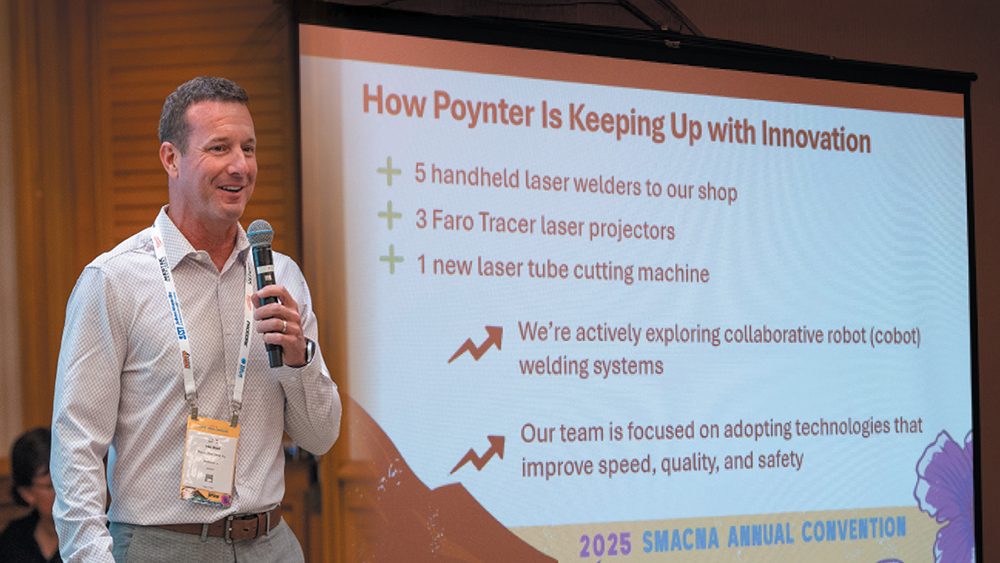
Architectural: How Automation is Reshaping Metalcraft Robotic welding is quietly remaking the architectural metals shop floor, turning once-manual, high-skill bottlenecks into predictable, data-driven production lines that can keep pace with the boldest designs. At Poynter, Director of Specialty Metals Luke Bland has become one of the loudest voices arguing that automation is no longer a futuristic luxury. In fact, it’s important for any fabricator who wants to stay in the game.A Shop at a CrossroadsOn a typical day, Bland walks through Poynter’s architectural metals operation with a checklist running in his head: labor gaps, tight schedules, demanding architects and the constant pressure to make every weld look as good as it performs. “We’re dealing with labor shortages, rising production demands and higher quality expectations than ever — something has to give,” he saysThe “something,” in his view, is no longer craftsmanship but the way that craftsmanship is delivered. Poynter has invested in handheld laser welders, laser projection systems and advanced cutting equipment as a bridge into a more automated future. Each purchase is a step toward a shop where humans guide the work rather than shoulder every repetitive task. “Our job now is to stay competitive, protect our workforce and still exceed what our customers think is possible,” Bland says.Why Welding Became the BottleneckArchitectural metals have always lived at the intersection of beauty and structural performance, but that balance is getting harder to maintain with traditional methods alone. Jobs keep getting more intricate — from sweeping façades to sculptural stair systems — while the pool of qualified welders shrinks and the cost of repair work climbs. “I can’t find enough people with the right skills, and when I do I can’t afford to waste them on rework,” Bland says.He describes welding as the choke point that everything else in the project squeezes through. Delays at the weld cell cascade into blown schedules in the field, rushed installs and expensive fixes when inconsistent quality shows up on site. “Customers expect a consistent aesthetic now; they notice when one panel reads differently from the next,” he says.Robots That Can Read the BlueprintThe new generation of welding automation that Poynter is exploring looks very different from the fenced-off, single-purpose cells that once defined robotic work. Mechanized, fully-robotic and emerging collaborative systems can now handle complex paths, tight tolerances and thin architectural materials that used to belong firmly in the realm of human finesse.Instead of asking a programmer to write code line by line, modern systems lean on path generation software, point and click tools, simplified pendants and offline programming that lets teams “teach” the robot in a far more intuitive way. “We used to think you needed a dedicated engineer and weeks of training; now the tech is catching up with how people actually work,” Bland explains.One of the biggest hurdles in architectural work is simply getting unique, often oversized parts into position for a robot to reach. In some cases, that means building smart, modular tooling: tables, fixtures and adjustable nests that can be rearranged and fine-tuned quickly for different projects.In other situations, the answer is the opposite: the automation comes to the parts. Modular robotic platforms, adjustable mounts and magnetic bases now allow welding systems to travel along large façades, frames or trusses, turning what used to be a field welding nightmare into a controlled, repeatable process. “We have to be flexible; the work we do doesn’t fit in a neat box or on a single fixture,” Bland says.For Bland, the most radical change may not be the robotic arm itself, but the invisible layer of data that surrounds it. Camera monitoring, live dashboards and weld data capture are beginning to turn each pass of the torch into a measurable, traceable event rather than a black box. “If we can see what’s happening in real time, we can stop treating quality as something we ‘inspect in’ at the end,” he says.Automated testing and integrated monitoring allow teams to catch variations early, tune parameters on the fly and build a history of how successful welds behave on different materials and joints. In an industry where a flawed weld can mean both aesthetic failure and long-term structural questions, that level of transparency is quietly revolutionary.Combining the Best of Man and MachineBland likes to frame Poynter’s automation journey as a layered ecosystem, not a single machine. Five handheld laser welders now give crews the speed and low distortion benefits of laser in a flexible format, while three laser projectors guide layouts and assembly, so parts reach the weld cell lined up correctly the first time. “Every piece of tech we add has to hit the same goals: speed, quality and safety,” he says.The shop has also added a laser tube cutting machine, which turns out precisely cut, repeatable components that make robotic welding far more predictable. Bland and his team are actively evaluating collaborative welding robots — cobots that can be wheeled up to a table or even to large assemblies — to handle repetitive joints while human welders focus on the trickiest details. “We’re not trying to replace welders; we’re trying to give them the best tools we can,” he says.Automation does not erase the human factor; it changes who is needed and what they do. Bland is candid about the cultural and educational lift required to make advanced systems work. “You still need people who understand welding fundamentals; now you’re asking them to think like process owners, not just operators,” he says.Traditional robotic programming often demanded computer skills, engineering support and weeks of off-site classes, a barrier for smaller shops and mid-career welders. Newer interfaces, more intuitive software and collaborative modes are lowering that bar, but Bland argues that intentional training — time, mentorship and a clear path from hood down welding to supervising automated cells — is what will really move the needle.Beyond the Weld: What Comes NextLooking ahead, Bland sees a convergence of trends that will only accelerate this transformation: cheaper hardware, faster communication, more computing power and a tide of AI-driven tools that promise to make welding systems more adaptive and self-correcting. “You hear it everywhere — AI, AI, AI — but for us it’s about using that intelligence to make better decisions on the floor, not chasing buzzwords,” he says.For architects, that could mean bolder geometries and tighter tolerances without blowing budgets or timelines. For fabricators, it could mean a future where a leaner crew oversees a fleet of intelligent systems, turning out consistent, high-performance work while staying safer and more sustainable. “If we do this right, automation doesn’t shrink what we can build,” Bland says. “It expands it.”
by John Crowley | Mar 6, 2026 | Uncategorized
The Connector: How Frank Wall’s collaborative vision is shaping
SMACNA’s next era. When Frank Wall steps into a room, he carries more than four decades of industry experience. He brings the confidence of someone who’s spent a lifetime building bridges between people who don’t always see eye to eye. On Jan. 20, that steady hand officially took the helm of the Sheet Metal and Air Conditioning Contractors’ National Association (SMACNA), marking a new chapter.For an association whose members sit at the intersection of technology, skill and labor, Wall’s appointment is a continuation of progress. “We’re pleased to be led by a professional with the leadership and industry skills necessary to navigate the challenges ahead,” explains Todd Hill, SMACNA President. “He is the right person to take the helm in achieving our objectives.”From Portland Roots to National LeadershipBorn and raised in Northeast Portland, Wall’s story begins far from Washington, D.C. boardrooms and industry summits. “Growing up, I was surrounded by people who built things,” he says. “I learned the value of hard work, but also of community and how much more we can accomplish when we work together.”After earning a degree in journalism from the University of Oregon, Wall gravitated toward the world of associations, spaces where communication, negotiation and alignment mean as much as technical skill. His career took shape in Oregon’s mechanical contracting community, where he led the Plumbing and Mechanical Contractors Association of Oregon (PMCA). There, he developed a reputation for diplomacy and results, fostering partnerships between labor and management that centered on shared goals: professionalism, safety, productivity and expanding union market share.During that period, Wall didn’t just talk about collaboration, he institutionalized it. PMCA helped create a model of cooperation that gained national attention. His leadership earned him roles on several statewide boards, including the Oregon Workforce Development and Talent Board and the State Prevailing Wage Committee, where he influenced workforce policy and training standards.In 2018, Oregon Gov. Kate Brown recognized his contributions with the Driving Force Award, honoring his exceptional work in expanding workforce development opportunities across the state. It was a milestone that validated Wall’s belief that progress in the skilled trades comes from listening as much as leading.Building a National ProfileWall’s success in Oregon paved the way for a broader platform. At the Mechanical Contractors Association of America (MCAA), he served as Executive Director of Operations, overseeing the John R. Gentile Foundation and managing day-to-day operations at the association’s national headquarters.Those who’ve worked with him describe a leader who blends strategic thinking with a teacher’s patience. “He will bring the same dedication and steady leadership to SMACNA that he has demonstrated throughout his tenure with MCAA,” the association says. “His contributions have helped ensure MCAA remains strong, focused and well-positioned for the future.” Beyond administration, Wall engaged directly in workforce training and leadership education. As a faculty member with C. Richard Barnes & Associates, he facilitated programs for the unionized electrical industry, drawing on his communication background to translate complex labor dynamics into actionable leadership lessons.A Vision for SMACNA’s FutureNow, as CEO of SMACNA, Wall inherits both opportunity and challenge. The sheet metal and HVAC industries face sweeping technological change, evolving labor markets and increasing demands for energy-efficient solutions. Wall’s approach, grounded in consensus-building, could prove decisive.SMACNA, representing thousands of firms that design, fabricate and install ductwork, HVAC systems and architectural metal, has long prized technical excellence. Wall’s task is to ensure that excellence continues to equal influence. Early indications suggest that workforce development, contractor-labor collaboration and diversity in skilled trades will be key elements of his agenda.“He’s uniquely equipped to navigate a rapidly changing industry,” Hill says. “Frank understands that innovation and labor relations aren’t opposing forces; they’re partners in progress.”Leadership Through ServiceAway from the office, Wall’s life has been grounded by service. A longtime volunteer with the March of Dimes, he has held positions on its National Board of Trustees and National Volunteer Leadership Council, traveling the country to coach nonprofit boards on governance and strategic growth.His motivation, friends say, always loops back to the same idea: people first. Married to his wife Colleen for 45 years, with two sons and three granddaughters, Wall sees continuity — not change — as the heartbeat of leadership. As he says, “Whether it’s in a family, a team or an industry, you build from trust.”
by John Crowley | Mar 6, 2026 | Uncategorized
Strengthening LaborHarmony and Industry Bonds I’m honored to serve as CEO of SMACNA, stepping forward at a pivotal time for our 3,500 member firms and the sheet metal, HVAC and fabrication sectors we represent. This isn’t about starting a new chapter; it’s about building on the solid foundation of strong leadership, proven advocacy and a commitment to collaboration that has guided this organization for decades.In my years with MCAA, I’ve stressed that labor relations aren’t a side issue; they’re the bedrock of our success. When labor and management view each other as opponents, we all lose time, money and opportunities. But when we sit on the same side of the table tackling shared challenges, we foster safer jobsites, skilled careers and thriving contractors. The strongest agreements shine on a project’s toughest day, when both sides affirm, “We prepared for this together.” That principle guides my leadership at SMACNA.SMACNA’s history is a testament to this philosophy. Our organization has long championed labor-management cooperation through joint apprenticeships, safety initiatives, productivity innovations and the adoption of advanced technology. Contractors benefit from stable, highly trained workforces, while unions succeed by partnering with organizations that invest in people and bid responsibly. These shared goals remain our north star as we confront ongoing labor shortages and drive innovation across the industry.One of the most powerful ways we bring these principles to life is by connecting in person. Our upcoming events are designed not just for learning, but for shaping the future of SMACNA’s advocacy, education and support.On April 12 to 14 at the 2026 SMACNA Fab Forum, presented by Milwaukee Tool, in Rosemont, Illinois, you can get a tour of The Hill Group’s 26-acre, full-service mechanical contracting organization, including the 104,000-square-foot prefabrication shop and 80,000-square-foot modular construction space. This is in addition to shop fabrication-focused educational breakout sessions. On May 6 to 8, join us for SMACNA’s Washington, D.C. Leadership Conference. This inaugural event serves as the successor to the CEA National Issues Conference, featuring a trade show, networking and legislative advocacy.Then, on June 1 to 3, join SMACNA and NEMI at AIHA Connect 2026 (Booth 1104) in New Orleans, Louisiana, and on Aug. 2 to 5 at the 2026 Health Care Facilities Innovation Conference (Booth 101) at the Minneapolis Convention Center to learn the latest in Testing, Adjusting and Balancing (TAB), including NEMI’s training and certification programs and SMACNA’s latest work that supports improved Indoor Air Quality. These gatherings are more than dates on a calendar. They are opportunities to turn principles into action, strengthen partnerships and shape the future of our industry. As CEO, I am committed to advancing SMACNA’s legacy through deeper labor harmony, smarter collaborations and meaningful experiences that prepare us for the challenges ahead. I look forward to meeting you, hearing your insights and working together to build a stronger, more resilient industry. Frank WallCEO, SMACNA
by John Crowley | Jan 14, 2026 | Uncategorized
The Majority of SMACNA Members Need a CTO The phrase “what gets measured, gets managed” is everywhere, but it raises a better question: What exactly are we measuring? How do we decide which numbers matter most? How do we know if we are improving?There is no single right answer. Every shop, project, and company has its own priorities. The real goal is consistency. Measure something, measure it the same way every time,and review it regularly. Over time, those consistent measurements become a mirror that reflects both progress and weakness.Many shops track familiar metrics such as pounds per hour, weld inches, lineal feet, machine utilization or ratios of fittings to straights. These provide a snapshot of productivity and can be tracked across time. But they also have limits. Increasing coil line output might look like a win, but if that creates a bottleneck in assembly or shipping, what did you really improve? Metrics can highlight success, but they can also hide inefficiencies elsewhere in the system.The danger lies in using isolated numbers as if they tell the whole story. Real insight comes from connecting each metric to the total workflow. When viewed together, performance patterns emerge. A spike in one area might explain a slowdown in another. That bigger picture is where true improvement happens.Early in my construction technology career, I chased point solutions. Each one solved a narrow problem, such as spooling, tracking or reality capture. Each win felt like progress, but every fix revealed a new issue downstream. The problem was that those tools worked in isolation. Today, software platforms connect estimating, coordination, fabrication, logistics and installation. For the first time, we can see the whole system. That visibility means our measurements must evolve as well.Systems thinking changes the question from “Are we improving this step?” to “Does this change improve the entire process?” Poorly chosen metrics can drive behavior that looks productive but hurts overall flow. When people chase metrics that do not align with company goals, they can optimize for local success rather than overall health.Revenue is a good example. It is easy to compare and feel like growth, but it is not always meaningful. High revenue does not guarantee profit or stability. Chasing top-line growth through low-margin work can drain cash and morale. For fabrication-heavy firms, better indicators might include lower rework, higher field productivity driven by improved shop output, or a growing share of projects that leverage your prefabrication strengths.Once the right metrics are in place, benchmarking gives them value. Tracking your own results over time shows progress and reveals backslides. Comparing to peers adds context. Peer groups are especially valuable because they collectively define metrics and openly share results, making comparisons fair and useful.Benchmarking should not be about competition for its own sake. It should provide perspective. It shows whether your systems can scale, whether your profit margins are in line with peers, and where you can improve.Metrics also drive alignment. What you choose to measure tells your teams what matters most. It connects daily work to company goals and helps people see how their efforts contribute to progress. When the wrong metrics are emphasized, they can confuse or demotivate teams, pulling them in opposite directions.Metrics are a mirror. They reflect your priorities, your values, and your company’s health. Like training at the gym, progress takes time and consistent effort. The results appear slowly, but they build into something powerful.So, ask yourself: Are you measuring what truly matters?Travis Voss is the Director of Innovative Technology and Fabrication at SMACNA. He leverages his background in the tech field to explore, adapt and potentially develop technologies and workflows for the construction industry, particularly as it undergoes its digital transformation.
by John Crowley | Jan 14, 2026 | Uncategorized
Navigating Tariffs, Tax Incentives, and Workforce Priorities TARIFFS AND MATERIAL COSTS: A MAJOR CHALLENGE AMID SUPPLY CHAIN UNCERTAINTYTariffs remain a significant factor destabilizing supply chains and driving up material costs crucial to HVAC and sheet metal work, such as aluminum. Recent tariff hikes, notably driven by the Trump administration’s legacy policies, have increased market uncertainty and largely functioned as hidden taxes, inflating input costs for contractors. Analysts warn of ongoing price instability due to limited domestic capacity for critical metals.To mitigate the impact of tariffs, contractors may rely on several contractual and regulatory tools under the Federal Acquisition Regulation (FAR). For example:FAR 52.229-3 permits contract price increases to reflect newly imposed federal taxes, such as tariffs, provided those taxes were not anticipated in bid pricing.Economic Price Adjustment clauses (FAR 52.216-4) may allow contractors to request price adjustments if material cost indices rise due to tariffs.Those working under flexibly priced contracts can seek cost recoveries consistent with FAR 31.201-2, which defines the allowability and allocability of such costs.Practically, contractors are advised to pre-purchase materials where feasible, identify domestic suppliers, update contract pricing provisions to accommodate cost passes, and scrutinize existing agreements for tariff-related relief or escalation clauses. These steps are vital to protect margins amid ongoing tariff volatility.LEGISLATIVE MOMENTUM ON TAX INCENTIVES BOOSTS ENERGY EFFICIENCY PROJECTSSeveral key tax provisions favorable to HVAC and sheet metal contractors remain on track or have been extended through bipartisan efforts under the House-passed H.R. 1 and related reconciliation packages. These include:Section 179D Energy Efficient Commercial Building Deduction allows up to $5 per square foot deductions for energy upgrade work in new or renovated projects. This incentive supports contractors specializing in energy-efficient systems.Bonus Depreciation and Section 179 Expensing enable faster write-offs for equipment and property investments, which can improve cash flow for contractors upgrading fleets or tooling.Advanced Manufacturing Investment Tax Credits (boosted from 25% to 35%) tied to CHIPS Act-facilitated domestic facility expansions open opportunities on construction projects supporting semiconductor and clean energy manufacturing.45Q Carbon Sequestration and 45U Nuclear Energy Credits provide indirect support to contractors involved in cutting-edge clean energy infrastructure. While a political tug-of-war persists between the House and Senate over the full package, with the Senate pushing back on some health and deficit elements, the energy-related tax incentives critical to HVAC and sheet metal scopes are expected to be preserved and potentially expanded in the upcoming 2026 tax extender bills.WORKFORCE DEVELOPMENT AND LABOR STANDARDS REMAIN A PRIORITYSMACNA advocates continue to press Congress to bolster workforce development by supporting Registered Apprenticeship Programs (RAPs) and enforcing prevailing wage laws, which are critical for union contractors. These efforts align with the demand for a highly skilled workforce capable of meeting technical challenges posed by advanced energy efficiency and federal infrastructure initiatives.Efforts to close employee misclassification loopholes and promote Project Labor Agreements (PLAs) drive policy aims to level the playing field and protect contractor competitiveness and labor standards.ENERGY AND INFRASTRUCTURE INVESTMENTS FEED PROJECT OPPORTUNITIESMassive federal investments under the Inflation Reduction Act (IRA), the expanded 35% tax credit within the CHIPS and Science Act, and the bipartisan Infrastructure Law continue to catalyze large-scale construction projects, from energy-efficient buildings to advanced manufacturing plants. Despite some delays and freezes on approved projects due to budget office constraints and legal challenges, the general outlook for CHIPS and data center projects is positive. These initiatives continue to generate sustained demand for HVAC and sheet metal contractor services, particularly for energy-efficient terminal upgrades in transportation hubs, commercial retrofit,s and new clean energy facilities.POLITICAL ENGAGEMENT AND ADVOCACY MOVING FORWARDSMACNA’s political engagement efforts continue to emphasize growing bipartisan support on Capitol Hill for policies that advance contractors’ economic interests. The outlook stresses building a strong, engaged coalition of legislators to embrace key industry priorities, tax incentives, and favorable regulatory frameworks.SMACNA is expanding efforts at the state and local level, promoting far greater legislative outreach, education, and targeted advocacy to complement federal actions.Contractor members have been encouraged to serve as “legislative ambassadors” and to participate, share updates, and insights to reinforce SMACNA’s industry voice in policymaking venues.Contractors who stay informed and engaged with ongoing political developments, workforce initiatives, and evolving contract rules will continue to be best positioned to safeguard profitability and capitalize on the transformative projects defining the industry’s future.
by John Crowley | Jan 14, 2026 | Uncategorized
Uncertainty is the New Normal Rebecca Patterson talks about the economy, tariffs, and AI with the SMACNA Annual Convention audience. Rebecca Patterson, a globally recognized investor and macroeconomic researcher, took the SMACNA Annual Convention stage at a tipping point in economic history. This year, the challenges facing leaders in construction, procurement, and business are sharper than ever, driven by rising tariffs, shifting policy, and the accelerating march of artificial intelligence (AI).Patterson, known for her tenure at Bridgewater Associates, Bessemer Trust, and JPMorgan, and for her inclusion on American Banker’s list of Most Powerful Women in Finance for six consecutive years, delivered candor and clarity to an audience eager for direction. 2025: A YEAR OF RISK AND RESILIENCE“Tariffs and related policies like export controls and countervailing duties are clearly the big issue this year for supply chains,” Patterson says, underscoring both the uncertainty and inflationary pressures dogging businesses nationwide. “Prices will go higher — the question is not if, but exactly when and by how much.” Her words resonate at a time when procurement and supply chain leaders are grappling with confusion over exemption levels and political winds, with national economic emergency tariffs hanging in the balance.When asked what keeps her up at night in 2025, Patterson is direct. “We have an uncomfortable number of questions that create risk for procurement leaders,” says the current member of the Council on Foreign Relations, the Economic Club of New York, and the Trilateral Commission. “What if America’s national economic emergency tariffs are deemed illegal? What countries are at risk of seeing tariff levels changed or delayed again?”Given these unknowns, she advises leaders to “avoid where possible the ‘known risk areas’ — both specific goods and countries in the White House’s crosshairs — then stick to business as usual, purchasing what’s needed.”THE DOUBLE-EDGEDSWORD OF AICurrent conversations in boardrooms are equally focused on the bottom line and on workforce disruption, Patterson shares.“Given changing cost dynamics, companies are searching for efficiency gains and other ways to manage budgets. This increasingly includes using AI to reduce needed headcount,” she says.She recently told Amazon’s Business Reshape audience that companies faced with rising input and AI-investment costs, along with economic uncertainty, are “planning to scale back headcount going into 2026.” In her words, “The bias is that more job cuts are coming. The offsets are personnel.”LIVE DATA, MARKET MOVES AND UNCHARTED TERRAINAsked what indicators she watches closely, Patterson says, “labor-market data is top of mind. Fewer jobs would mean less spending, and that would flow through not just the U.S., but also the global economy.”She also points to the risk of politicized central banks, warning, “If the Fed becomes politicized, you risk unanchored inflation expectations, which hurts confidence, markets, and consumers.”Still, Patterson tries to balance realism with resourcefulness. “The best approach may be to try to avoid known risk areas, but stick to business as usual otherwise,” she advises. If there’s one message she hopes leaders remember, it’s to pay attention, innovate, and never bet purely on yesterday’s playbook. At a “truly historic moment for the global economy,” as she calls it, that advice is more urgent than ever.